


Vietnamese Rice Paper Manufacturers: What You Actually Need to Check Before Signing a Supply Deal
Search “rice paper manufacturer Vietnam” and you’ll get dozens of factories calling themselves “leading” or “premium.” Almost none of them can answer the two questions that actually matter: what’s your lead time, and who are you currently supplying? If a supplier can’t answer those on the first call, that’s the real red flag — not the lack of a fancy website.
Search “rice paper manufacturer Vietnam” and you’ll get dozens of factories calling themselves “leading” or “premium.” Almost none of them can answer the two questions that actually matter: what’s your lead time, and who are you currently supplying? If a supplier can’t answer those on the first call, that’s the real red flag — not the lack of a fancy website.
Vietnam is where rice paper was born, and it’s still the world’s largest, most experienced production base for it. But heritage alone doesn’t make a factory export-ready. Here’s what actually separates a real production partner from a factory that simply “also makes rice paper.”
Why Vietnam Became the World’s Rice Paper Capital
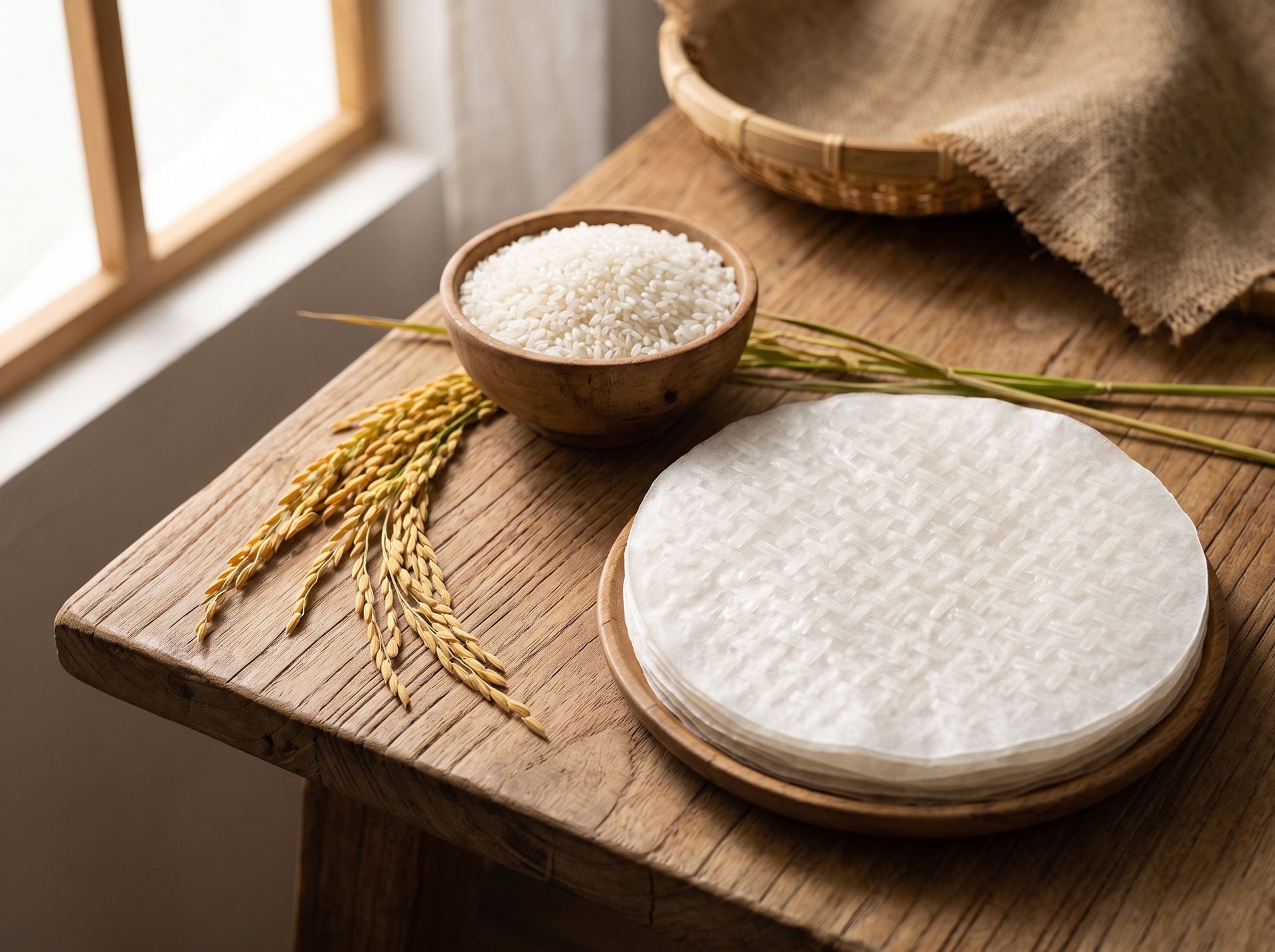
Nobody invented rice paper in a lab, and no company holds a patent on it. It grew out of generations of rice-farming culture in Vietnam, especially in the Mekong Delta and the central-southern provinces. Once wet-rice agriculture shaped daily life, people found ways to turn rice into food that traveled and kept better: rice noodles, pho, hu tieu — and rice paper.
A handful of regions became known for their own style, and those names still carry weight with buyers today:
- Trảng Bàng (Tây Ninh) — known for soft rice paper, the “dew-dried” style (bánh tráng phơi sương)
- Củ Chi (Ho Chi Minh City)
- Quảng Nam, Bình Định
- Bến Tre, Đồng Tháp
This regional depth is exactly why Vietnam — and not any other rice-growing country — became the natural center of rice paper production, and why so many export factories today can still trace their roots back to one of these craft villages.
From Craft Village to Export Factory: What Actually Changed
The ingredients haven’t changed — it’s still rice flour, water, salt. What’s changed is the infrastructure needed to serve buyers who can’t tolerate any difference between batch #1 and batch #5,000. That shift shows up as:
- Automated steaming and drying lines instead of open-air drying racks
- Documented hygiene and quality control procedures
- Batch-level traceability
- Internationally recognized food safety certifications
This is really the line that separates a craft-village-style operation from an actual Vietnamese rice paper manufacturer capable of supplying retail chains, e-commerce platforms, and private-label programs overseas.
The Numbers a Trustworthy Manufacturer Should Be Able to Give You
A serious manufacturer backs things up with real figures, not reassurance. As a benchmark, here’s what a Vietnamese rice paper factory with 10+ years of export experience typically discloses about its own operation:
- Production Capacity and Lead Time
- Rice paper output: tons per month
- Rice noodle / pho / vermicelli output: tons per month
- Average lead time: days from order confirmation to goods ready for shipment
- Flexible MOQ, workable for both SMEs and large retail or distribution accounts
If a factory can’t give you even a rough number for monthly capacity or lead time, that usually points to one of two things: they haven’t scaled past small-batch production, or they simply don’t track these numbers. Either way, that’s a limiting signal for a buyer planning recurring orders.

Certifications — and What Each One Actually Tells You
Each certification answers a different question:
- FSSC 22000 / ISO 22000 — is the factory’s overall food safety management system internationally recognized?
- FDA registration — can this product legally clear customs into the US?
- KFDA-equivalent standards — does the factory meet Korea’s import requirements, one of the strictest markets for Vietnamese rice paper?
- Halal certification — can the product serve Muslim markets?
A factory holding all five isn’t just “fully certified” on paper — it’s a signal they’ve actually been through compliance processes for several demanding markets at once, a different bar entirely from a factory that only sells domestically.
Product Specs You Should Be Asking For
Before signing anything, ask for a spec sheet — not just a sample. For standard white rice paper, that spec sheet should typically cover:
- Ingredients: rice flour, tapioca starch, salt — no wheat, naturally gluten-free, non-GMO
- Shape: round, square, triangle
- Sizes: commonly 16cm, 18cm, 22cm, 28cm, 31cm, 32cm
- Packaging: 300g, 340g, 500g, 1kg, and 5kg bulk
- Shelf life: typically 2 years
- HS code for customs classification
Manufacturers with a broader catalog also offer organic rice paper (naturally colored with turmeric, beetroot, butterfly pea) and green tea rice paper — worth looking into if you’re sourcing for a retail segment that wants shelf differentiation rather than just another commodity product.
5 Checks for Evaluating a Vietnamese Rice Paper Manufacturer
Once you have real numbers in hand, picking a reliable supplier comes down to five concrete checks:
1. Food Safety Certifications
Ask to see the certificates directly — FSSC 22000, ISO 22000, FDA, KFDA, Halal, depending on your target market — and verify with the issuing body if your order size justifies it.
2. Export Experience and Documentation
A factory that has shipped under FOB, EXW, CIF, or DDP terms, and has already handled a Certificate of Origin and a Health Certificate, will get your first shipment through customs far more smoothly than one still learning the ropes. This matters enough to deserve its own checklist — see what to verify with a Vietnamese rice paper exporter.
3. Track Record — Who Are They Actually Supplying?
This is the fastest gut check: ask which retail chains, distributors, or e-commerce platforms they currently supply. A manufacturer already shipping to a known retail account or marketplace has effectively already passed someone else’s vetting process — and that tells you more than any sales deck will.
Common Mistakes Importers Make
Choosing on price alone, then eating the cost later when quality isn’t consistent
Skipping the lead-time conversation, then discovering a 45-day wait right after placing the first PO
Never asking who else buys from the factory — existing retail or e-commerce accounts are one of the clearest trust signals there is
FAQ
Is Vietnam still the best place to source rice paper?
Vietnam is both the birthplace of rice paper and its most experienced production base, combining decades of craft-village know-how with export-grade manufacturing infrastructure.
How do you verify a manufacturer’s certifications are genuine?
Ask to see the certificates directly, and for larger orders, verify with the issuing body. A transparent manufacturer will never hesitate when you ask.
Tanisa Foods is one such export-ready manufacturer. Founded in 2015 by Estelle Thu — who grew up in Tây Ninh, a region long known for traditional rice-paper craft — Tanisa now runs a fully automated production line (both forming and drying) and holds FSSC 22000, ISO 22000:2018, FDA, KFDA, and Halal certifications. The company currently ranks among the top 2 rice paper exporters to South Korea and supplies accounts including H-Mart (US), Amazon US, Coupang (South Korea), and Wildberries (Russia) — while still sourcing its rice from the Mekong Delta, the region that gives Vietnamese rice paper its characteristic texture.
TANISA FOODS JSC, a strong brand in the market for the production and distribution of specialty products (rice paper, rice noodles...) and spices (seasoning) which exported to some countries such as USA, France, South Korea, Japan, Russia, Brunei...
TANISA FOODS JSC
Factory add 1: 188 Lac Long Quan Street, Quarter 3, Tan Ninh Ward, Tay Ninh Province, Vietnam
Factory add 2: Phu Hoa Dong, Cu Chi, Ho Chi Minh City, Viet Nam
Office in HCMC: 18th Floor, Vincom Building, 72 Le Thanh Ton Street, District 1, Ho Chi Minh City, Vietnam
Warehouse in HCMC: 2/3 Binh Gia, Tan Binh District, Ho Chi Minh City, Vietnam
Hotline: +84 938 118 699 (WhatsApp/WeChat), +84 938 198 299 (Zalo)

Email: marketing@tanisagroup.com
Website: www.tanisagroup.com
Facebook: Tanisa Foods JSC
Instagram: @tanisa_foods
Youtube: Tanisa Kitchen

Xem thêm