



Why Rice Paper Is Different from Other Types of Wraps
Discover what makes rice paper different from tortillas and other wraps, from its gluten-free ingredients to its versatility, texture, and everyday uses.
Order a burrito, and you already know what kind of food to expect. Choose a flatbread, and the menu immediately narrows toward Mediterranean or Middle Eastern cuisine. Most wraps come with a built-in culinary “script” — except for one.
Rice paper breaks that pattern entirely. Understanding why helps explain why it is increasingly appearing in meal-prep boxes, healthy eating blogs, and kitchens thousands of miles away from Southeast Asia.
What Makes Rice Paper Different, in One Sentence
Most wraps tell you what kind of dish you are making before you even add the filling. Rice paper does not.
It is a thin, gluten-free wrapper made from rice flour and water that takes on the shape and flavor of whatever you put inside. That is why it works equally well for a Vietnamese fresh spring roll, a crispy snack, or an entirely new dish of your own creation.
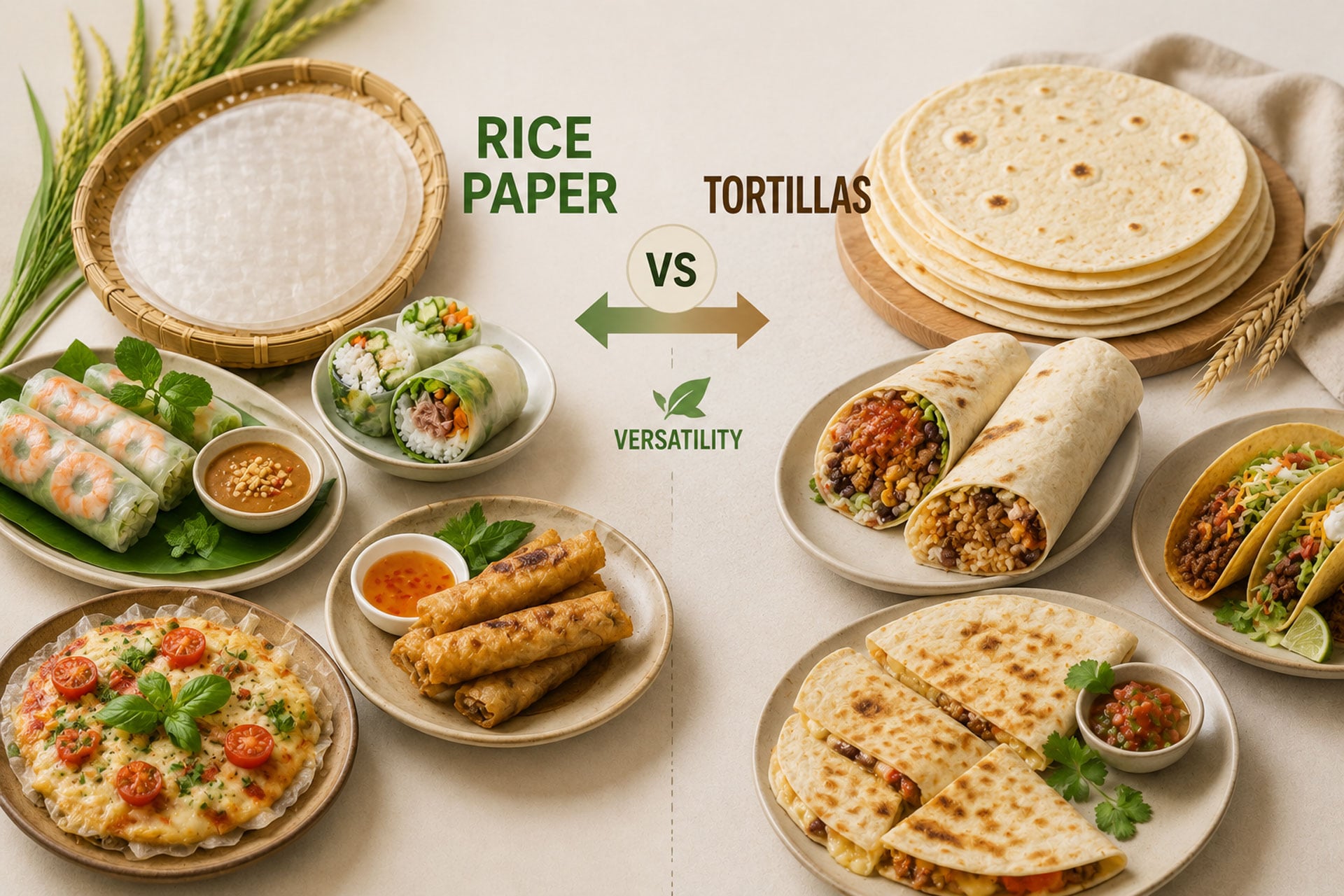
Most Wraps Come with Their Own “Rules”
Think about the last time you held a wrapped dish in your hands. Chances are, the wrapper itself had already decided much of the dish for you.
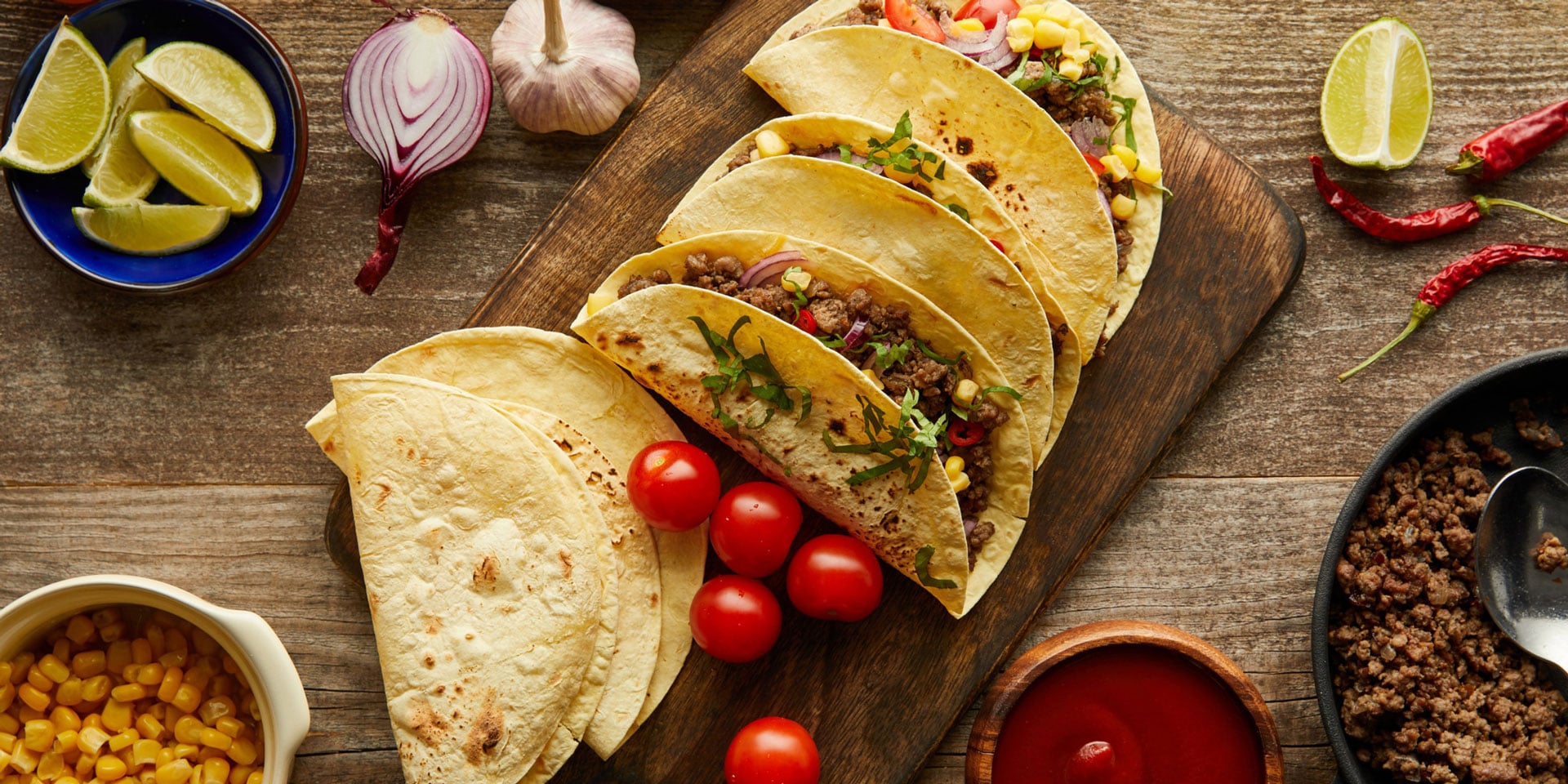
Tortillas Are Closely Tied to One Culinary Tradition
A tortilla immediately suggests a burrito, taco, or quesadilla before you add a single ingredient. Its flavor and texture are deeply associated with Mexican and Tex-Mex cuisine. Step too far outside that framework — by wrapping miso-dressed vegetables inside, for example — and the result can feel more mismatched than creatively fused.
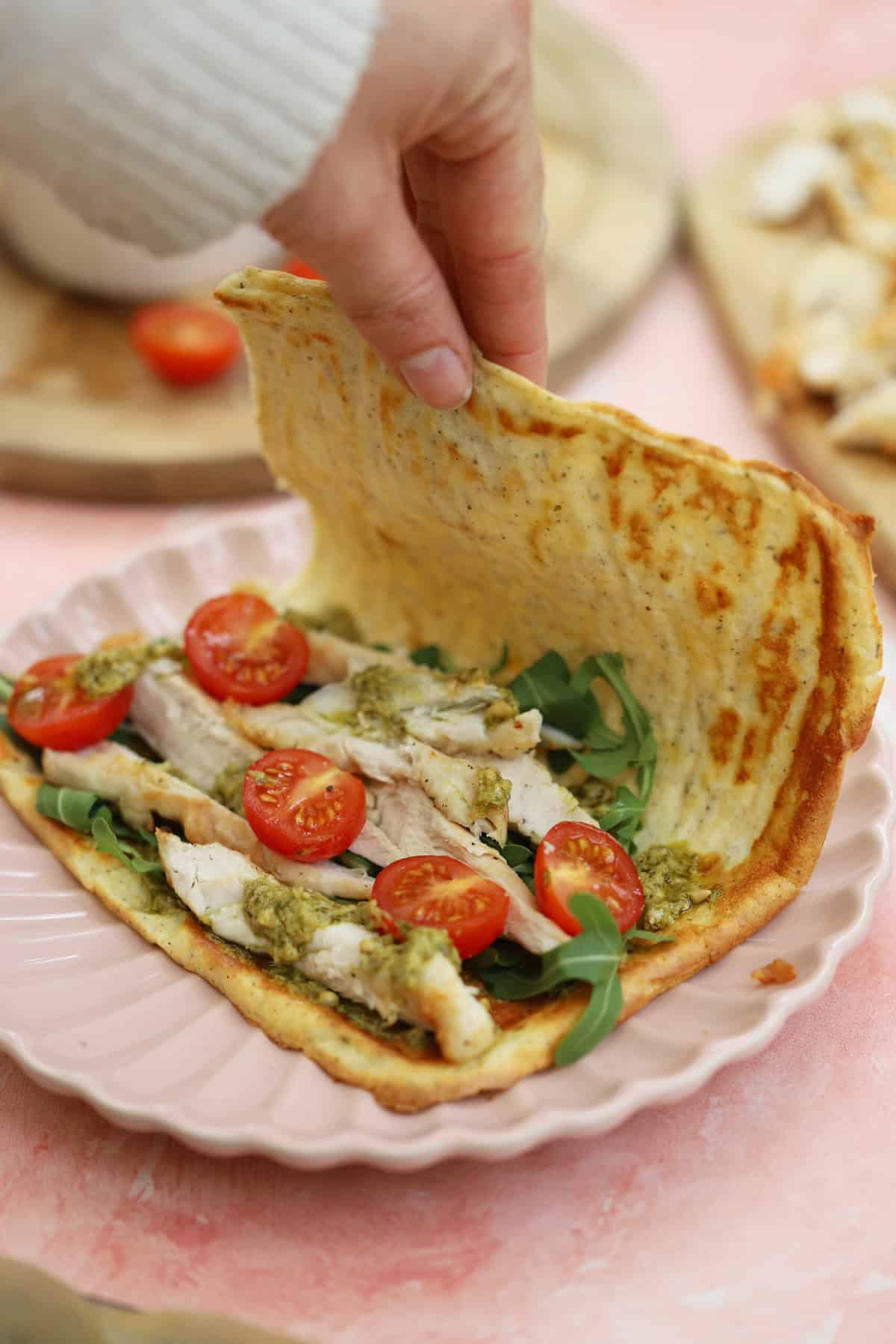
Flatbreads Come with Their Own Expectations
Flatbreads work in much the same way. Pita, naan, and lavash naturally bring a dish toward a particular regional identity. They are designed to be sturdy and chewy — excellent for something like a gyro, but their density can make them less suitable for light, fresh fillings.
Sandwich Wraps Follow Sandwich Logic
Even conventional sandwich wraps operate according to sandwich logic: clearly structured layers, a defined top and bottom, and a texture that generally works best cold or lightly toasted.
It is a predefined format rather than a blank canvas for culinary creativity.
Rice Paper Does Not Define the Dish — It Adapts to It
This is the real difference, and it is fundamental rather than merely stylistic.
Rice paper has an almost neutral flavor, while its texture changes depending on how you prepare it. It becomes soft and pliable after a quick dip in water, crisp when fried, and pleasantly chewy when cut into strips.
It does not ask the filling to adapt to the wrapper. The wrapper adapts to the filling.
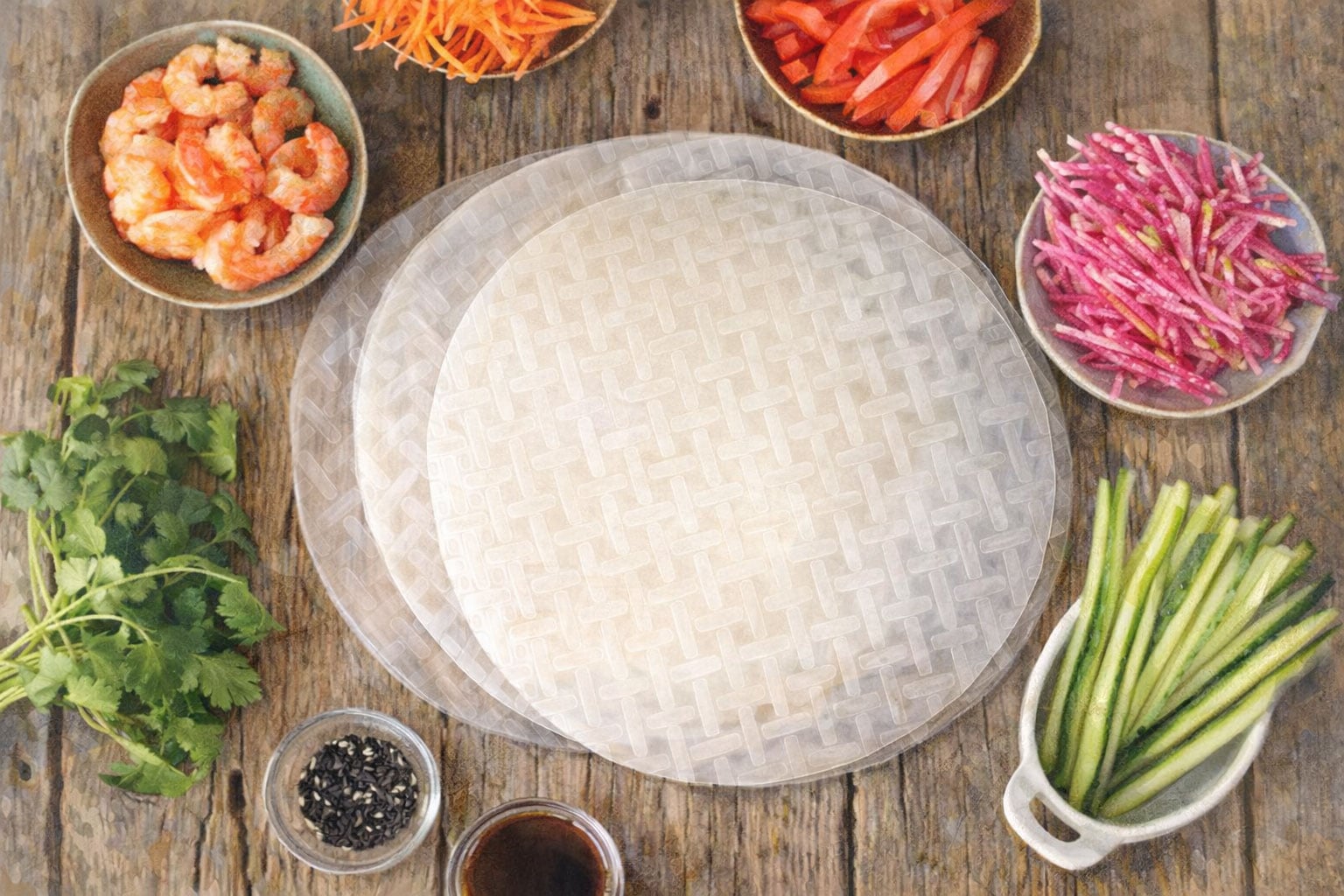
Lighter — When You Look at the Numbers
Dry rice paper has an energy density of approximately 300–330 kcal per 100 g, based on USDA FoodData Central data. However, because an individual sheet typically weighs only around 4–8 g, that works out to roughly 15–30 calories per sheet.
Flour tortillas have a similar energy density — approximately 310–320 kcal per 100 g — but each tortilla weighs considerably more, often around 30–60 g. That translates to roughly 90–180 calories per tortilla. Flour tortillas also commonly contain oil or fat in their formulation, while traditional rice paper does not.
In practical terms, using two or three sheets of rice paper instead of one flour tortilla can often save approximately 60–150 calories, depending on the sizes being compared. The exact difference varies by brand, size, and thickness.
A Simpler Ingredient List
Traditional rice paper has a remarkably short ingredient list: rice flour, water, and sometimes a small amount of tapioca starch to improve flexibility and chewiness.
There is no yeast, no gluten, and no need for the dough-conditioning ingredients commonly found in many other types of wraps.
For people who pay attention to ingredient labels — whether because of gluten intolerance or simply because they prefer to avoid highly processed foods — that simplicity is a core benefit rather than a minor detail.
More Versatility in Texture and Preparation
Because rice paper starts out dry and crisp, you have considerable control over its final texture.
A quick dip in cold water makes it ready for fresh rolls. Double-layering two sheets creates enough strength to hold saucier fillings without tearing. Fry it, and rice paper transforms into a crisp shell that feels more like a snack than a conventional wrap.
Few other wrappers offer that range of textures from a single product.
What Can You Actually Make with Rice Paper?
Most articles stop at fresh spring rolls. That significantly underestimates what rice paper can do.
Fresh, No-Cook Dishes
The classic Vietnamese fresh spring roll is only the beginning.
Rice paper also works well as a fresh vegetable wrap for a lighter lunch, a sushi-inspired roll filled with rice and fish, or even a fruit-and-yogurt roll for a simple no-cook snack.
Cooked and Crispy Dishes
Pan-fried or air-fried, rice paper becomes golden and crispy, creating a naturally gluten-free alternative for crispy rolls or quesadilla-style creations.
Beyond Savory Dishes: Snacks, Fusion Food, and Desserts
Because rice paper has almost no strong flavor of its own, it has quietly become a platform for dishes far removed from traditional Vietnamese cuisine.
It can be turned into seasoned crispy chips, dessert rolls filled with fruit and sweet sticky rice, or even crispy pan-fried rice paper “pizza.”
These kinds of experiments are much harder to achieve with a wrapper that already carries a strong culinary identity of its own.
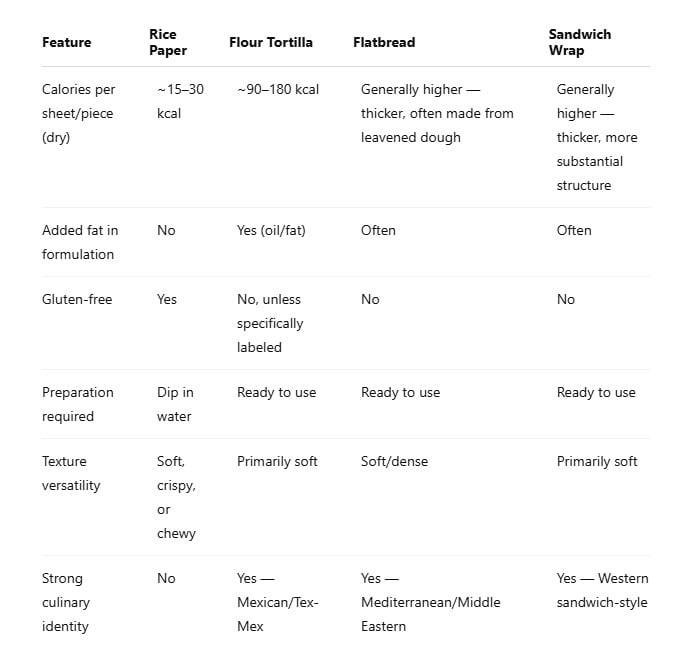
Estimated calorie figures are based on published energy-density data from USDA FoodData Central for dry rice paper and flour tortillas. Actual values vary depending on brand, size, and thickness. Figures for flatbreads and sandwich wraps are intended only as general guidance because products such as pita, naan, and lavash vary considerably.
How to Use Rice Paper Properly: A Beginner’s Guide
How to Dip Rice Paper in Water
Use cold or room-temperature water rather than warm water. Warm water can soften rice paper too quickly, making it sticky and difficult to handle.
Dip each sheet for only a few seconds. The rice paper will continue to soften even after you remove it from the water.
Common Mistakes to Avoid
Over-soaking is the most common mistake. The sheet becomes too soft and may tear as soon as you try to roll it.
The solution is simple: remove the rice paper while the edges still feel slightly firm.
Overfilling is the second common mistake. Rice paper is flexible, but its elasticity has limits. A moderate amount of filling spread evenly across the sheet will produce much better results than trying to pack too much inside.
Who Is Rice Paper Best For?
Rice paper is particularly suitable for:
People following a gluten-free diet who want a naturally gluten-free wrapper rather than a substitute product
People looking for a lighter, lower-calorie alternative to many wheat-based wraps
Home cooks who want quick and convenient meals, including fresh dishes that require no cooking
Anyone who enjoys experimenting with fusion cuisine, because rice paper does not compete with the flavors placed inside it
Frequently Asked Questions About Rice Paper
Is Rice Paper Healthier Than Tortillas?
Rice paper is generally lower in calories per sheet, naturally gluten-free, and traditionally contains no added oil or fat, making it a lighter option for many diets.
However, whether the final dish is “healthy” ultimately depends on the filling and preparation method, not just the wrapper itself.
Can Rice Paper Be Used for Hot Dishes?
Yes. Rice paper can hold up well in pan-fried preparations and can also be incorporated into soups and stir-fried dishes, in addition to being used for fresh and cold recipes.
Is Rice Paper for Fresh Rolls Different from Rice Paper for Frying?
Yes. At Tanisa Foods, we produce two distinct types of rice paper: one specifically designed for frying and another designed for fresh rolls.
Does Rice Paper Have a Flavor of Its Own?
Very little — and that is precisely what allows it to absorb and complement the flavors of virtually any filling you choose.
The Real Advantage of Rice Paper
The true advantage of rice paper has never been simply that it is lighter than a tortilla or gluten-free compared with wheat-based bread. Those are benefits, but they are not the whole story.
Its greatest strength is that it does not come with a predefined culinary “script.”
A tortilla tells you what kind of dish you are making. Rice paper waits for you to decide.
That same principle — a simple, adaptable product that can work across different cuisines — is also one reason rice paper has become one of Vietnam’s distinctive food exports, bringing authentic Vietnamese culinary heritage to consumers around the world.
Manufacturers such as Tanisa Foods, whose rice paper production meets FSSC 22000, ISO 22000, FDA, and Halal standards and whose products are exported to more than 30 countries, have built an entire portfolio around this versatility — from traditional white rice paper and clean-label, preservative-free products to vegetable and organic varieties.
For consumers, chefs, retailers, and food businesses looking for a wrap that adapts to their ideas rather than asking their ideas to adapt to the wrap, that flexibility is what makes rice paper fundamentally different.
TANISA FOODS JSC, a strong brand in the market for the production and distribution of specialty products (rice paper, rice noodles...) and spices (seasoning) which exported to some countries such as USA, France, South Korea, Japan, Russia, Brunei...
TANISA FOODS JSC
Factory add 1: 188 Lac Long Quan Street, Quarter 3, Tan Ninh Ward, Tay Ninh Province, Vietnam
Factory add 2: Phu Hoa Dong, Cu Chi, Ho Chi Minh City, Viet Nam
Office in HCMC: 18th Floor, Vincom Building, 72 Le Thanh Ton Street, District 1, Ho Chi Minh City, Vietnam
Warehouse in HCMC: 2/3 Binh Gia, Tan Binh District, Ho Chi Minh City, Vietnam
Hotline: +84 938 118 699 (WhatsApp/WeChat), +84 938 198 299 (Zalo)




Email: marketing@tanisagroup.com
Website: www.tanisagroup.com
Facebook: Tanisa Foods JSC
Instagram: @tanisa_foods
Youtube: Tanisa Kitchen

Xem thêm