


Rice Paper vs Tortilla: The New Wrap Trend on the Rise
How do rice paper and tortillas differ in nutrition, texture, and use? See why more people are choosing rice paper over tortillas.
Rice Paper: The New Wrap Trend Replacing Tortillas
Rice paper is thin, light, naturally gluten-free, and almost flavorless on its own, which lets it adapt to whatever filling goes inside it. The question isn't which one is absolutely better, but which one fits the dish being made, and lately, more and more people are choosing rice paper over the tortilla they're used to.
The Real Difference Between Rice Paper and Tortillas
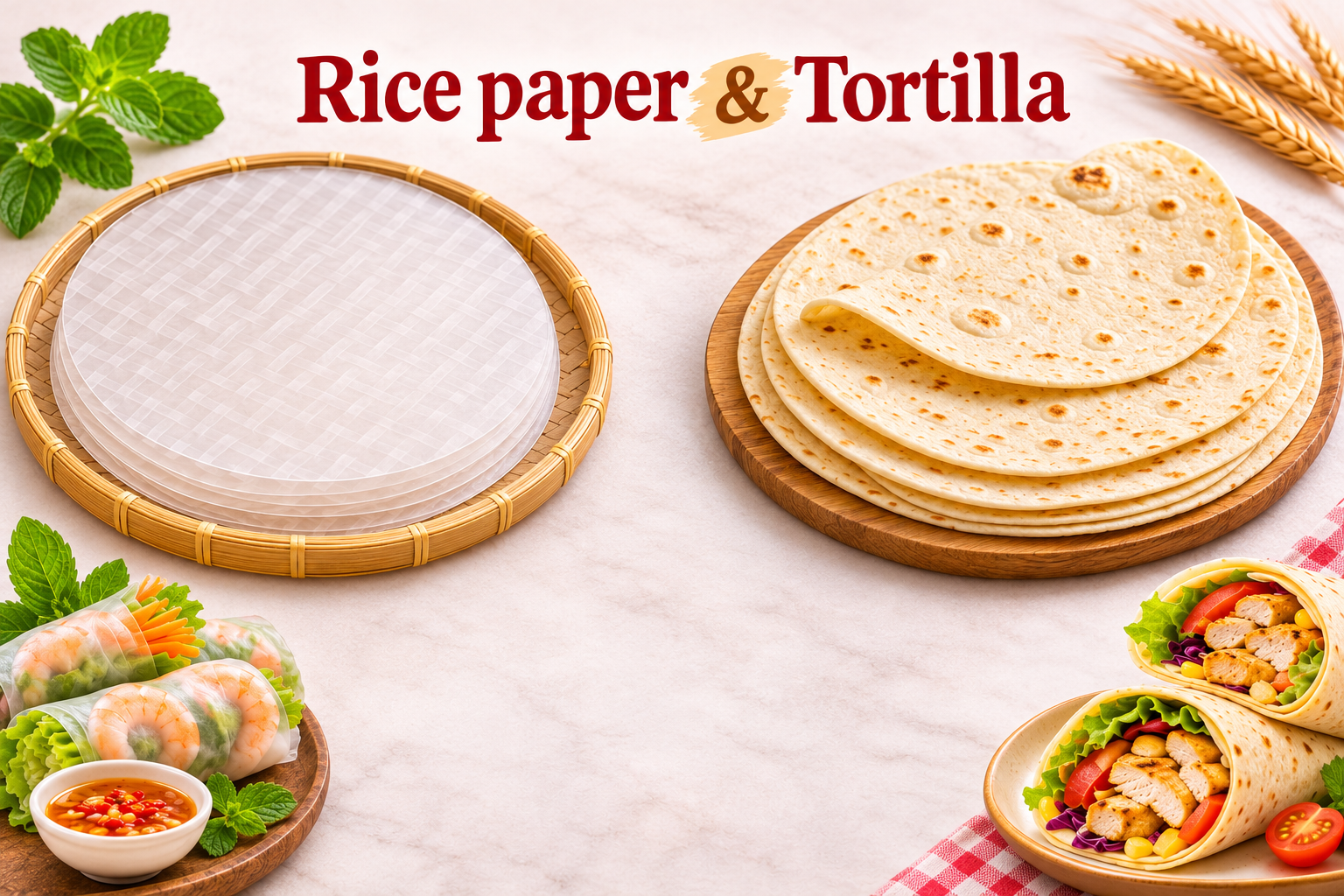
The difference starts with the ingredients. Rice paper (bánh tráng) is made from rice flour, tapioca starch, water, and a little salt. This mixture is spread into a thin layer, steamed, then dried. At Tanisa, this entire process is done by machine to keep the thickness consistent across every production batch. Tortillas are quite different: wheat or corn flour is mixed with fat, rolled thin, and cooked directly on a hot surface.
This difference is exactly what determines how each one is used. Rice paper needs to be soaked in water before rolling, which is why it turns soft, pliable, and almost translucent. A tortilla can be used right away or reheated, and it keeps its sturdy, chewy texture all the way through a meal, even when wrapped around a heavy filling.
Flour Tortilla, Corn Tortilla, and Rice Paper: Three Wraps, Three Different Recipes
One point that often gets lumped together by mistake: not every tortilla is the same. Flour tortillas, made from wheat flour, contain gluten and have a chewy, soft texture. Corn tortillas, made from corn flour, are gluten-free but more brittle and tear more easily when folded.
Rice paper sits in a category of its own: gluten-free from the start, thin and translucent, and the only one of the three that needs to be soaked in water before use.
Nutrition: Calories, Carbs, Protein, and Gluten
Looking at calories alone, rice paper is noticeably lighter. A standard sheet of rice paper, around 15 grams, falls somewhere between 16 and 48 calories depending on thickness and brand, while a medium flour tortilla, around 30 grams, usually falls between 90 and 150 calories. That gap is wide because tortilla dough has added oil or fat, while rice paper has almost no fat at all, under 1 gram of protein and close to 0 grams of fat per sheet.
As for gluten, traditional rice paper contains none, since it's made entirely from rice. Flour tortillas do contain gluten because they're made with wheat flour. Corn tortillas don't, though they're less common than flour tortillas in many markets.
The Viral "Tortilla Wrap" Trend Is Turning Into Rice Paper
Over the past few years, folding a tortilla into a stuffed, multi-section wrap has become one of the biggest food trends on TikTok, pulling in billions of views combined. What stands out is that within this same trend, more and more videos are switching from tortillas to rice paper, mainly for two reasons: cutting the calories of the wrapper itself, and giving gluten-free eaters a way in without losing the eye-catching visual effect the trend is known for on camera.
A few variations are being widely shared: a crispy fried-egg wrap made with rice paper instead of tortilla, a "candy fold" version packed with several small filling pockets, and a modern fresh-roll-style version made with noodles, vegetables, and protein instead of the usual filling.
Why Are TikTok Users Choosing Rice Paper Over Tortilla for This Trend?
The reason isn't just about calories. Rice paper is thin and translucent, so when filmed up close, the colors of the filling show through clearly, something an opaque, dense tortilla can't do. Combined with being gluten-free, rice paper ends up appealing to two groups at once: people who want to eat lighter and people who need to avoid gluten.
Which One Should You Choose? A Guide Based on Your Needs
Rice paper works well when you need a naturally gluten-free option, want a lighter, lower-calorie dish, or you're making fresh rolls, crispy fried wraps, or fusion dishes that mix different cuisines. Because it's almost flavorless on its own, rice paper doesn't impose a flavor on the dish, so it can wrap seafood, vegetables, fruit, or even grilled meat without clashing.
Should Gluten-Free Eaters, Vegetarians, or People Watching Their Weight Choose Rice Paper?
For these three groups, rice paper is usually the sensible choice. Gluten-free eaters get traditional rice paper made from rice. Vegetarians or vegans get a wrap that's entirely plant-based, with no need to reformulate anything. People watching their calories get a wrapper that's much lighter than a tortilla, as long as the filling inside is chosen just as carefully, since a light wrapper doesn't automatically make the whole dish low-calorie.
Rice Paper Is Redefining the "Wrap" Category Around the World
A tortilla is tied to one specific cuisine. See a tortilla, and taco, burrito, or a Mexican or Tex-Mex style meal immediately comes to mind. The flavor of the corn or wheat flour also shapes part of the eating experience before anything else does.
Rice paper doesn't carry that kind of "rule" with it. Because it's almost flavorless, it gets used in very different ways from place to place. In Korea, it's gradually replacing lettuce leaves for wrapping grilled meat and kimchi at BBQ or hot pot meals, since it holds sauce better and doesn't wilt under heat. In Japan, some sushi restaurants use rice paper instead of seaweed sheets to create a different, softer, chewier texture. In Europe, rice paper is layered and baked to create a crispy, pastry-like texture. In the US, it shows up as a lower-carb alternative to tortillas, or as the wrapper for fruit rolls and crispy fried snacks.
A Tortilla Shapes the Dish, Rice Paper Adapts to It
This is the core difference between the two wraps. A tortilla decides in advance what flavor direction a dish will take. Rice paper leaves that decision to the cook, and that's exactly why it moves so easily across different cuisines without ever feeling out of place.
Frequently Asked Questions
Is rice paper healthier than tortillas? In terms of calories and fat, yes. Rice paper is lighter and naturally gluten-free. "Healthier" depends on each person's dietary goals, there's no single answer that applies to everyone.
Can rice paper replace tortillas in burritos or quesadillas? Yes, with some conditions. Rice paper works well for fresh rolls, cold wraps, or crispy fried wraps. With a hot burrito that has a lot of wet filling and needs a tight, secure fold
Does rice paper taste like tortillas? No. Soaked rice paper is nearly flavorless, while tortillas, especially corn ones, carry their own distinct flavor from the grain itself.
Tanisa: Export-Standard Rice Paper
If you're looking for a reliable source of rice paper, Tanisa Foods is worth considering. The product is made from rice grown in Vietnam's Mekong Delta, following clean-label principles: naturally gluten-free, non-GMO, and free of preservatives. Tanisa holds FSSC 22000, ISO 22000, FDA, KFDA, and Halal certifications, and currently exports to more than 35 countries, including the US, Europe, South Korea, Japan, and Australia.
TANISA FOODS JSC, a strong brand in the market for the production and distribution of specialty products (rice paper, rice noodles...) and spices (seasoning) which exported to some countries such as USA, France, South Korea, Japan, Russia, Brunei...
TANISA FOODS JSC
Factory add 1: 188 Lac Long Quan Street, Quarter 3, Tan Ninh Ward, Tay Ninh Province, Vietnam
Factory add 2: Phu Hoa Dong, Cu Chi, Ho Chi Minh City, Viet Nam
Office in HCMC: 18th Floor, Vincom Building, 72 Le Thanh Ton Street, District 1, Ho Chi Minh City, Vietnam
Warehouse in HCMC: 2/3 Binh Gia, Tan Binh District, Ho Chi Minh City, Vietnam
Hotline: +84 938 118 699 (WhatsApp/WeChat), +84 938 198 299 (Zalo)




Email: marketing@tanisagroup.com
Website: www.tanisagroup.com
Facebook: Tanisa Foods JSC
Instagram: @tanisa_foods
Youtube: Tanisa Kitchen

Xem thêm