


What Is FSSC 22000 Certification? A Guide for Food Buyers
Learn what FSSC 22000 certification means, how it differs from ISO 22000, and the exact steps to verify a supplier's certificate before you order.
What Is FSSC 22000 Certification, and How Do You Verify a Supplier's Certificate?
FSSC 22000 is a food safety management system certification recognized by the Global Food Safety Initiative (GFSI) under its benchmarking standard. It is built on the ISO 22000 standard, adding sector-specific prerequisite programs along with extra requirements such as food fraud prevention and food defense. For buyers, an FSSC 22000 certificate is evidence that a factory's hazard control systems and quality processes have been independently assessed by an accredited certification body — not an absolute guarantee for every shipment, but a reliable starting point when evaluating a supplier.
The latest version of the scheme has been recognized against GFSI's updated benchmarking requirements, and it is now applied across more than 40,000 certified sites worldwide. For importers, this scale matters: FSSC 22000 is no longer just an optional advantage — it has become a default requirement on the supplier lists of many retailers and major brands, alongside standards such as BRCGS or SQF.
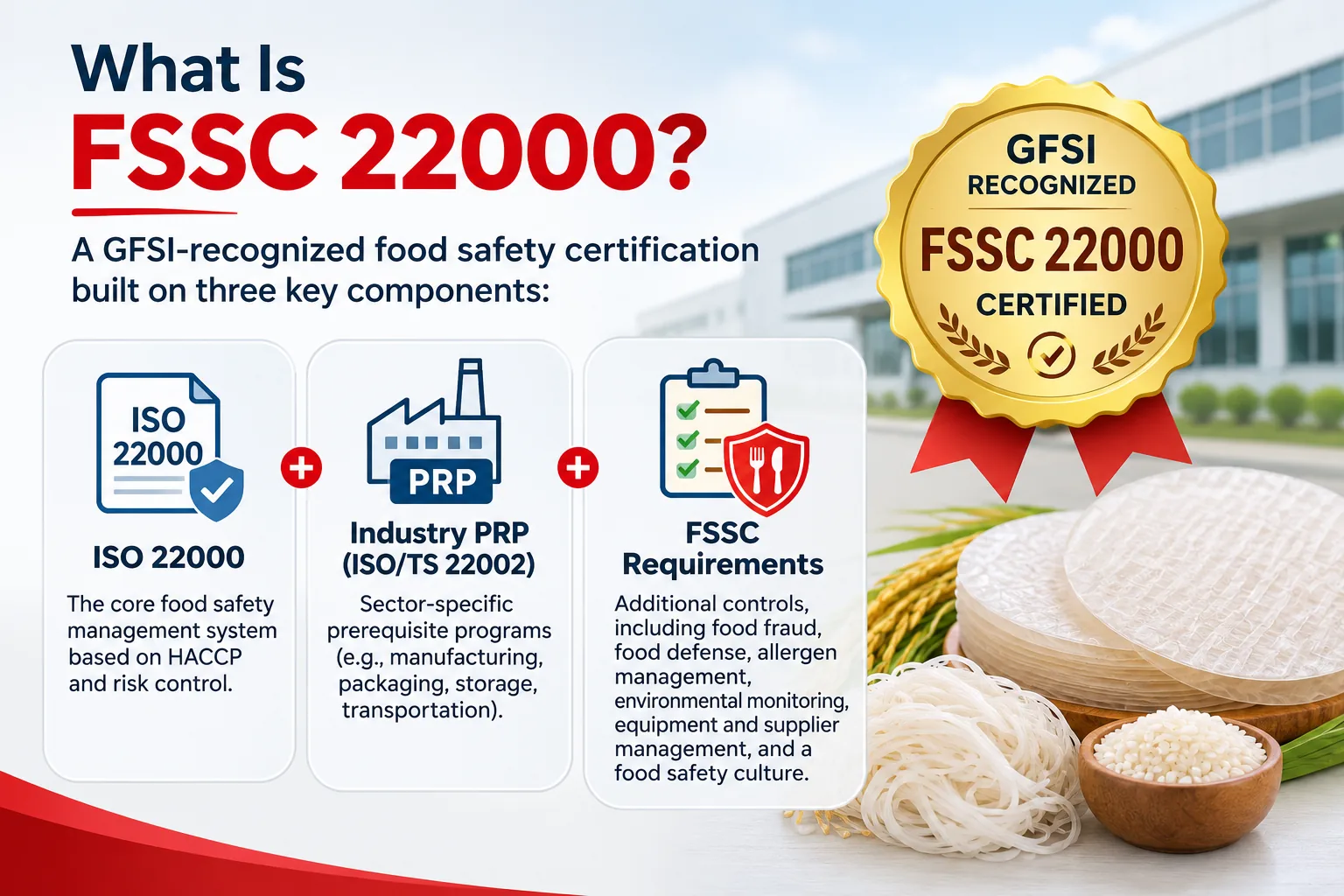
What Is FSSC 22000, Exactly?
FSSC 22000 is not a single set of documents — it combines three layers of requirements into one certification:
- ISO 22000 — the core food safety management system framework, built on HACCP principles and a risk-based approach to hazard control.
- Sector-specific prerequisite programs (PRPs) — technical standards from the ISO/TS 22002 series that set out detailed operational controls for each food sector, such as manufacturing, packaging, or storage and transport.
- FSSC's own additional requirements — scheme-specific rules that go beyond ISO 22000, including food fraud mitigation, food defense, allergen management, environmental monitoring, management of purchased services and materials, equipment management, and food safety and quality culture.
Which Businesses Need This Certification
Any organization that processes, manufactures, packages, stores, or transports food can be certified under FSSC 22000, provided a relevant food chain category and PRP standard exist for its activities. That's why the scheme appears across so many different industries — from rice-based food manufacturing to dairy, seafood, and food packaging production.
Why GFSI Recognition Matters to Buyers
Because FSSC 22000 is recognized by GFSI and approved by the International Accreditation Forum (IAF), a certificate issued under the scheme is, in principle, accepted by supply chains and retailers around the world without each buyer needing to run its own separate audit. This is the main reason many import contracts and retailer supplier-onboarding forms list FSSC 22000 as an accepted — or required — certification.
FSSC 22000 vs. ISO 22000: What Actually Differs for a Buyer
The two terms are often used interchangeably, but they are not the same thing, and the difference directly affects how much you can rely on a given certificate.
| Aspect | ISO 22000 Alone | FSSC 22000 |
| GFSI recognition | Not automatically recognized | Recognized by GFSI |
| Prerequisite programs (PRPs) | General PRPs, not sector-mandated | Sector-specific PRPs mandatory (ISO/TS 22002 series) |
| Additional requirements | No explicit requirement for food defense/food fraud | Food fraud, food defense, allergen management, and more are mandatory |
| Who can issue the certificate | Any accredited certification body | Only certification bodies licensed by the Foundation for Food Safety Certification |
| Audit scope | ISO 22000 clauses only | ISO 22000 + PRP standard + FSSC-specific requirements, assessed together |
When a Buyer Should Require FSSC 22000 Instead of ISO 22000 Alone
If your own customers — a retailer, a brand, or a government import program — require a GFSI-recognized scheme, a certificate based on ISO 22000 alone will not satisfy that requirement. You specifically need FSSC 22000, BRCGS, SQF, or another GFSI-recognized scheme. When in doubt, ask the supplier for the actual certificate rather than assuming the two terms mean the same thing.
How a Factory Achieves FSSC 22000 Certification (Process, Timeline, Maintenance)
Achieving certification is a months-long project, not a one-time inspection:
- Study the scheme's documentation. The current FSSC 22000 requirements are published free of charge on the scheme owner's website, together with the relevant ISO/TS 22002-x PRP standard for the applicant's sector.
- Build or upgrade the food safety management system to meet HACCP-based hazard analysis, the prerequisite programs, traceability capability, and the FSSC-specific requirements listed above.
- Conduct an internal audit and management review, and close out any gaps found before inviting an external auditor.
- Go through a two-stage external audit. Stage 1 is a document review and readiness check; Stage 2 is an on-site audit where the audit team inspects the facility and records, observes actual operations, and interviews staff.
- Receive the certificate, which is then listed in the public database of certified organizations.
Certification is not a one-time event. Certified sites must go through annual surveillance audits, at least one unannounced audit every three years, and a full recertification audit every three years. According to published industry figures, the cost of initial certification (Stage 1 plus Stage 2) typically ranges from a few thousand to several tens of thousands of US dollars depending on the size and scope of the factory, with smaller fees for annual surveillance audits, and the entire process usually takes 6 to 12 months from project kickoff to certificate issuance.
Why the Unannounced-Audit Requirement Matters
A scheduled audit gives any factory time to prepare in advance. An unannounced audit checks whether the same controls — sanitation, documentation, staff practices — hold up on an ordinary production day, not only on the day the audit team shows up. For buyers, this is part of why FSSC 22000 carries more weight than a one-off inspection report.
How to Verify a Supplier's FSSC 22000 Certificate Before Placing an Order
A PDF certificate is easy to produce — and just as easy to fake. Before relying on one, work through this checklist:
- Look the company up by its Certified Organization ID (COID) — not just by name — in the scheme owner's public register of certified organizations. The COID is the unique identifier tied to that specific site's certificate.
- Match the certified scope and food chain category against the exact product you're sourcing.
- Check that the legal entity name and site address on the certificate match the factory that will actually produce your order — not a head-office address or a different branch that falls outside the certified scope.
- Check the issue and expiry dates against your planned production and shipping schedule, and ask for evidence of the latest surveillance or recertification status if the certificate is close to expiring.
- Confirm that the certification body itself is properly accredited — it must be licensed to issue FSSC 22000 certificates and accredited by an accreditation body that is a signatory to the IAF Multilateral Recognition Arrangement (MLA).
Warning Signs to Watch For
Treat any of the following as a reason to look further before placing an order: the certificate doesn't appear in the official public register at all, the certified scope doesn't match what the supplier claims, the site address doesn't match the factory you were shown, or the certificate has already expired.
FSSC 22000 Is One Part of the Bigger Supplier-Evaluation Picture
Even a verified, in-scope, currently valid FSSC 22000 certificate only tells you that a food safety management system exists and has been assessed. A thorough supplier evaluation still needs to cover the written specification (ingredients, dimensions, net weight, shelf life), sample testing for thickness, moisture, flexibility, and flavor consistency across different production batches, a packaging format suited to your market, and the export documents that will actually travel with the shipment: commercial invoice, packing list, bill of lading, certificate of origin, and health certificate. Certification narrows down the list of factories worth evaluating — it is not the final step.
Frequently Asked Questions About FSSC 22000 Certification
Is FSSC 22000 required to export food? No certification is absolutely required for every food export — the requirement depends on the destination market and the buyer. That said, many retailers and major brands require a GFSI-recognized scheme such as FSSC 22000 as a condition of doing business, which makes it a near-mandatory practical requirement for suppliers wanting access to those channels.
Is FSSC 22000 the same as ISO 22000? No. FSSC 22000 is built on ISO 22000 but adds mandatory sector-specific prerequisite programs and its own requirements, such as food fraud and food defense, and is certified under a scheme recognized by GFSI. ISO 22000 on its own does not carry that GFSI recognition.
How can I tell if a certificate is genuine and still valid? Look the company up by its COID in the scheme owner's official public register, then compare the scope, site address, and validity dates shown there with the certificate you were given. Don't rely on the appearance of a PDF alone.
How long does it take a factory to achieve FSSC 22000 certification? Most first-time certifications take roughly 6 to 12 months from project kickoff to certificate issuance, depending on how mature the factory's existing food safety system already is.
Tanisa's Food Safety Certifications
Tanisa Foods — a Vietnamese manufacturer of rice paper and rice-based food products exporting to more than 45 countries — holds FSSC 22000 certification along with ISO 22000:2018 certification covering the processing and packing of rice paper, rice paper snacks, crispy rice paper, and products made from rice, tapioca flour, and vegetables. Other certifications on the company's record include FDA registration (United States), KFDA registration (South Korea), and Halal certification.
Tanisa Foods JSC is a leading Vietnamese manufacturer of rice paper, rice noodles, and rice vermicelli, exporting to over 45 countries worldwide. We comply with international food safety standards, including FSSC 22000, ISO 22000:2018, FDA, KFDA, and Halal.
TANISA FOODS JSC
Factory add 1: 188 Lac Long Quan Street, Quarter 3, Tan Ninh Ward, Tay Ninh Province, Vietnam
Factory add 2: Phu Hoa Dong, Cu Chi, Ho Chi Minh City, Viet Nam
Office in HCMC: 18th Floor, Vincom Building, 72 Le Thanh Ton Street, District 1, Ho Chi Minh City, Vietnam
Warehouse in HCMC: 2/3 Binh Gia, Tan Binh District, Ho Chi Minh City, Vietnam
Hotline: +84 938 118 699 (WhatsApp/WeChat), +84 938 198 299 (Zalo)




Email: marketing@tanisagroup.com
Website: www.tanisagroup.com
Facebook: Tanisa Foods JSC
Instagram: @tanisa_foods
Youtube: Tanisa Kitchen

Read more