


Rice Paper Manufacturers: How to Vet One Before You Order
A 5-stage framework for evaluating rice paper manufacturers, from certifications and production methods to sample testing and shipping terms before you order.
Rice Paper Manufacturers: An Evaluation Framework Before You Order
Rice paper manufacturers are the factories that produce the rice paper sheets used for fresh spring rolls, fried spring rolls and many other wrapped dishes. Before choosing a factory, a buyer needs to check how its production and quality control actually work, and whether its export record fits the destination market.
What follows is a five-stage evaluation framework that helps you screen rice paper manufacturers more systematically before signing your first purchase order.
Stage 1: Shortlist by Certification and Export Market
The certifications you need depend on where you plan to sell the product. There is no single set of certifications that fits every market. The US market typically requires FDA registration, the South Korean market requires KFDA, markets with Muslim consumers need Halal certification, while FSSC 22000 and ISO 22000 are two food safety management certifications many importers use as a general screening criterion, regardless of the specific market.
| Destination market | Certification to ask for |
| United States | FDA |
| South Korea | KFDA |
| Markets with Muslim consumers | Halal |
| General food safety management | FSSC 22000, ISO 22000 |
Beyond certification, ask which specific markets the factory has already exported to, and which retail chains or e-commerce platforms it has worked with there. A factory already experienced with foreign retail chains tends to understand that market's packaging and labeling requirements better, rather than having to learn them from scratch once it takes on your order.
Stage 2: Compare Production Processes, Not Just Price
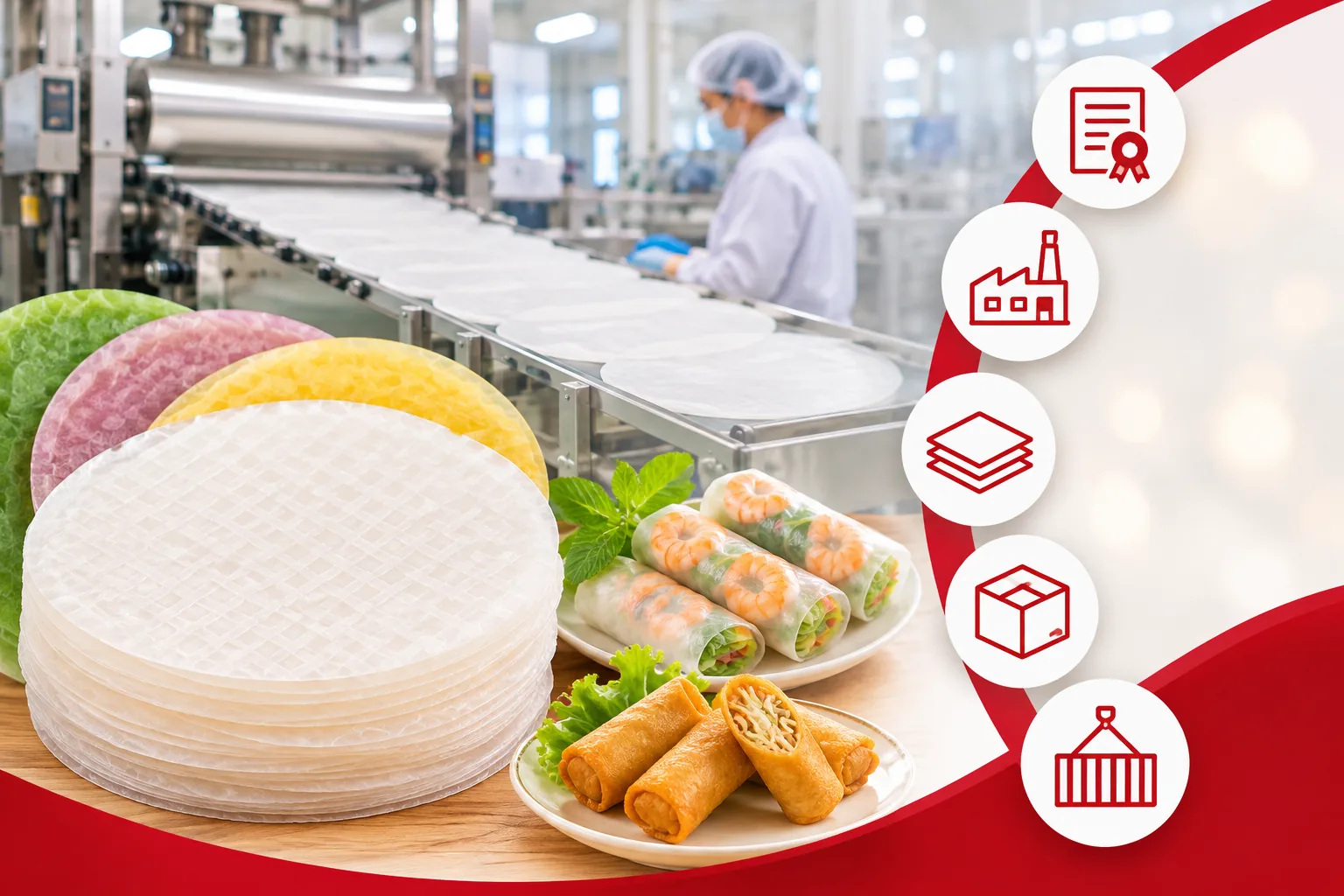
Traditionally made rice paper is usually dried outdoors on bamboo racks, which depends heavily on the weather. This method gives the product a handmade quality, but thickness and moisture can vary from batch to batch, especially during the rainy season. To meet large, consistent export orders, some factories have switched to a process of steaming followed by fully machine drying, which allows better control over thickness and moisture between batches.
At Tanisa, for example, the process is steaming the rice paper, then drying it 100 percent by machine, weighing the net weight and carrying out a final quality check before the product is stored and shipped out through the port.
Why the Drying Method Affects Flexibility When Soaked and Crispness When Fried
Rice paper used for fresh spring rolls needs to be thin enough to roll easily, yet strong enough not to tear when soaked and filled. If used for frying, it needs to turn crisp after frying and not stay greasy. Both qualities should be checked with an actual sample, not just taken from the factory's verbal description.
Stage 3: Request Samples and Test Them the Right Way
A good-looking sample alone isn't enough to decide on. How you test it should match how you'll actually use the product, since fresh spring rolls and fried spring rolls place different demands on the same sheet of rice paper.
What to Check on a Rice Paper Sample
- Check the dry sheet first, whether it's intact and evenly flat
- Soak it exactly as the factory instructs, avoiding over-soaking, which can skew the result
- Roll it with the actual filling used in your menu, and assess its flexibility and how well it holds together
- If frying is part of your use case, fry it with the same oil and process your kitchen uses, and check its crispness and oil retention
Stage 4: Agree on Specifications, Packing and MOQ Before Placing the Order
Before finalizing an order, you should agree on the following specifications with the factory: size and shape, ingredients, retail or bulk packing, private label capability, shelf life, minimum order quantity (MOQ), and shipping terms.
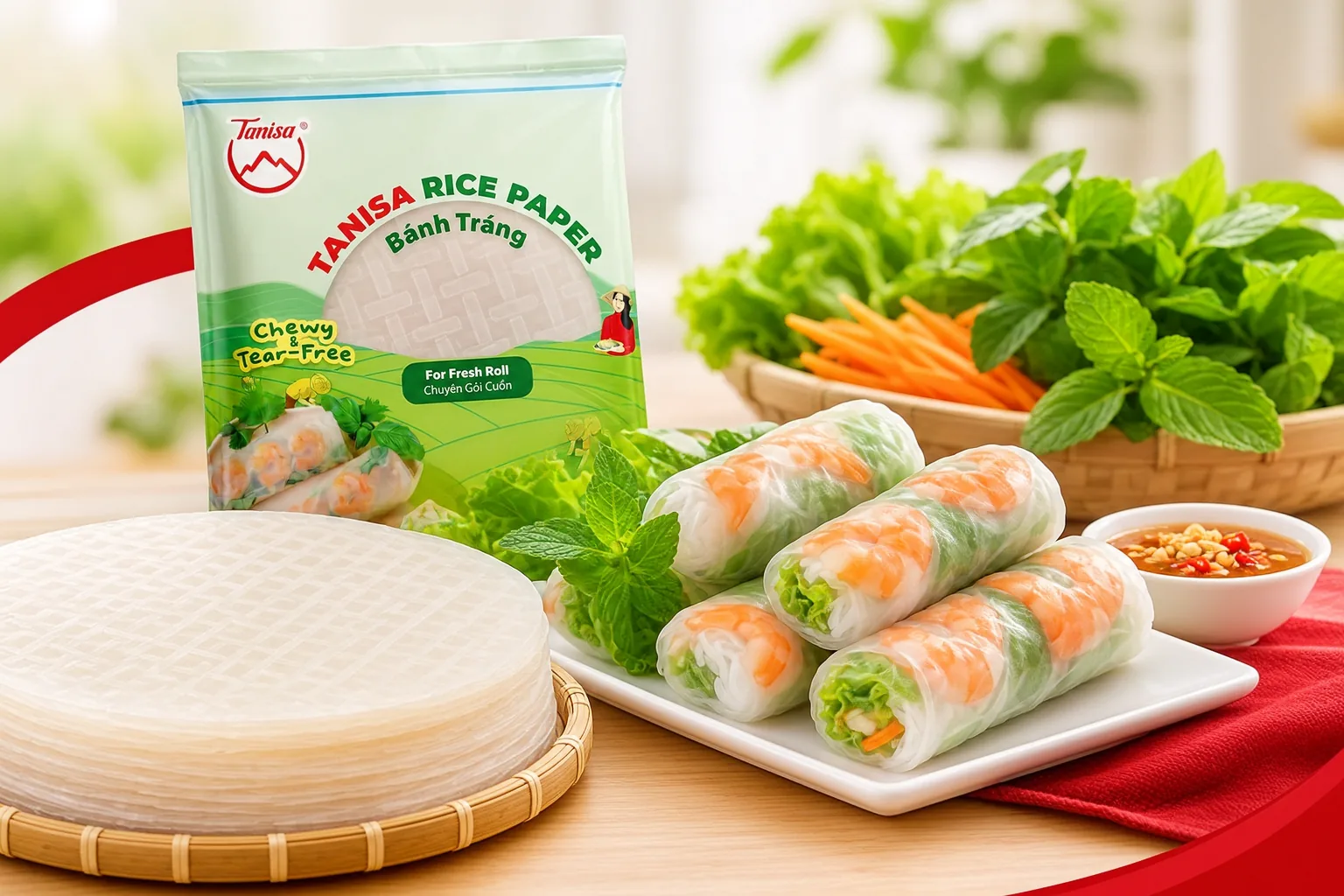
A specific example from Tanisa: for its retail line, rice paper is packed in a resealable zip bag with 38 sheets per pack. Besides the standard white rice paper line, the factory also has vegetable color rice paper, organic rice paper and green tea rice paper, available by default or made to order depending on the market.
Stage 5: Plan Logistics Around Three Fixed Milestones
You can build your working schedule around three milestones: specification approval, production completion, and vessel or truck booking. At Tanisa, the reference lead time is 20 to 30 days, while MOQ is confirmed for each specific order by the export team. Keep the approved sample, the final packing design, the packing list and related documents together as a reference file, for use when a distributor or customs authority needs to check something.
Shipping Terms Worth Clarifying Before Comparing Prices
FOB, EXW, CIF and DDP are the shipping terms commonly used in rice paper export deals, and each one assigns responsibility for transport, insurance and procedures differently at each stage of the journey. Clarify which term a factory is quoting before comparing prices between two suppliers, since a lower price may simply mean you're taking on more of the work yourself, not that the product itself is actually cheaper.
Vietnam on the Rice Paper Manufacturing Map
Rice paper is closely tied to Vietnam's rice-growing regions, with Tay Ninh being one of the areas best known for its traditional rice paper making. A number of long-established export factories are also concentrated in this region, which is often why it's the first place importers look when sourcing rice paper.
Frequently Asked Questions
What certifications should I ask about before placing an order? It depends on the destination market. The US market needs FDA, South Korea needs KFDA, markets with Muslim consumers need Halal, while FSSC 22000 and ISO 22000 are two food safety management certifications worth asking about regardless of market.
How many samples should I request before placing a large order? Request samples from at least two different production batches, so you can compare consistency across batches rather than judging from a single demo sample.
What's a realistic MOQ and production lead time? The exact figures vary by factory and by order. At Tanisa, the reference lead time is 20 to 30 days, while MOQ is confirmed by the export team for each specific order, depending on the product type and packing requirements.
Can the factory produce private label for my brand? Many export-oriented rice paper factories support private label or OEM production, but the exact capability depends on the market and order volume. Discuss this directly with the export team to confirm before finalizing your packaging design.
Running Tanisa through this five-stage framework, an importer will find: certifications including FSSC 22000, ISO 22000:2018, FDA, KFDA and Halal, along with an export history spanning more than 45 countries, including the United States, Europe, Australia, Japan and South Korea. Tanisa has also worked with retail chains and e-commerce platforms such as H-Mart, Don Quijote, Homeplus, Foodland, Amazon US and Coupang. Its reference lead time is 20 to 30 days, MOQ is confirmed per order, and the factory supports FOB, EXW, CIF and DDP shipping terms. If you're using this same framework to screen suppliers, you can contact Tanisa's export team directly for samples and specifications suited to your market.
Tanisa Foods JSC is a leading Vietnamese manufacturer of rice paper, rice noodles, and rice vermicelli, exporting to over 45 countries worldwide. We comply with international food safety standards, including FSSC 22000, ISO 22000:2018, FDA, KFDA, and Halal.
TANISA FOODS JSC
Factory add 1: 188 Lac Long Quan Street, Quarter 3, Tan Ninh Ward, Tay Ninh Province, Vietnam
Factory add 2: Phu Hoa Dong, Cu Chi, Ho Chi Minh City, Viet Nam
Office in HCMC: 18th Floor, Vincom Building, 72 Le Thanh Ton Street, District 1, Ho Chi Minh City, Vietnam
Warehouse in HCMC: 2/3 Binh Gia, Tan Binh District, Ho Chi Minh City, Vietnam
Hotline: +84 938 118 699 (WhatsApp/WeChat), +84 938 198 299 (Zalo)




Email: marketing@tanisagroup.com
Website: www.tanisagroup.com
Facebook: Tanisa Foods JSC
Instagram: @tanisa_foods
Youtube: Tanisa Kitchen

Read more