


FDA for Food: What It Really Means and How to Verify a Supplier
Learn what FDA food facility registration confirms, why it is not product approval, and how buyers can verify a supplier's records and certifications.
Many food importers search for "FDA certificate" when evaluating a supplier, but the FDA does not issue certificates for individual food products. What the agency actually requires is that facilities that manufacture, process, pack, or hold food for the U.S. market register under the Food Safety Modernization Act (FSMA). For a buyer, that registration confirms a facility has declared itself to the FDA.
Unlike drugs or medical devices, the FDA does not issue a certificate or approval for individual food products. The actual legal requirement is Food Facility Registration, which originated from the Bioterrorism Act of 2002 and now operates under the FSMA framework. Every facility within scope, whether based in the United States or abroad, must register with the FDA before its products are allowed into the U.S. food supply chain.
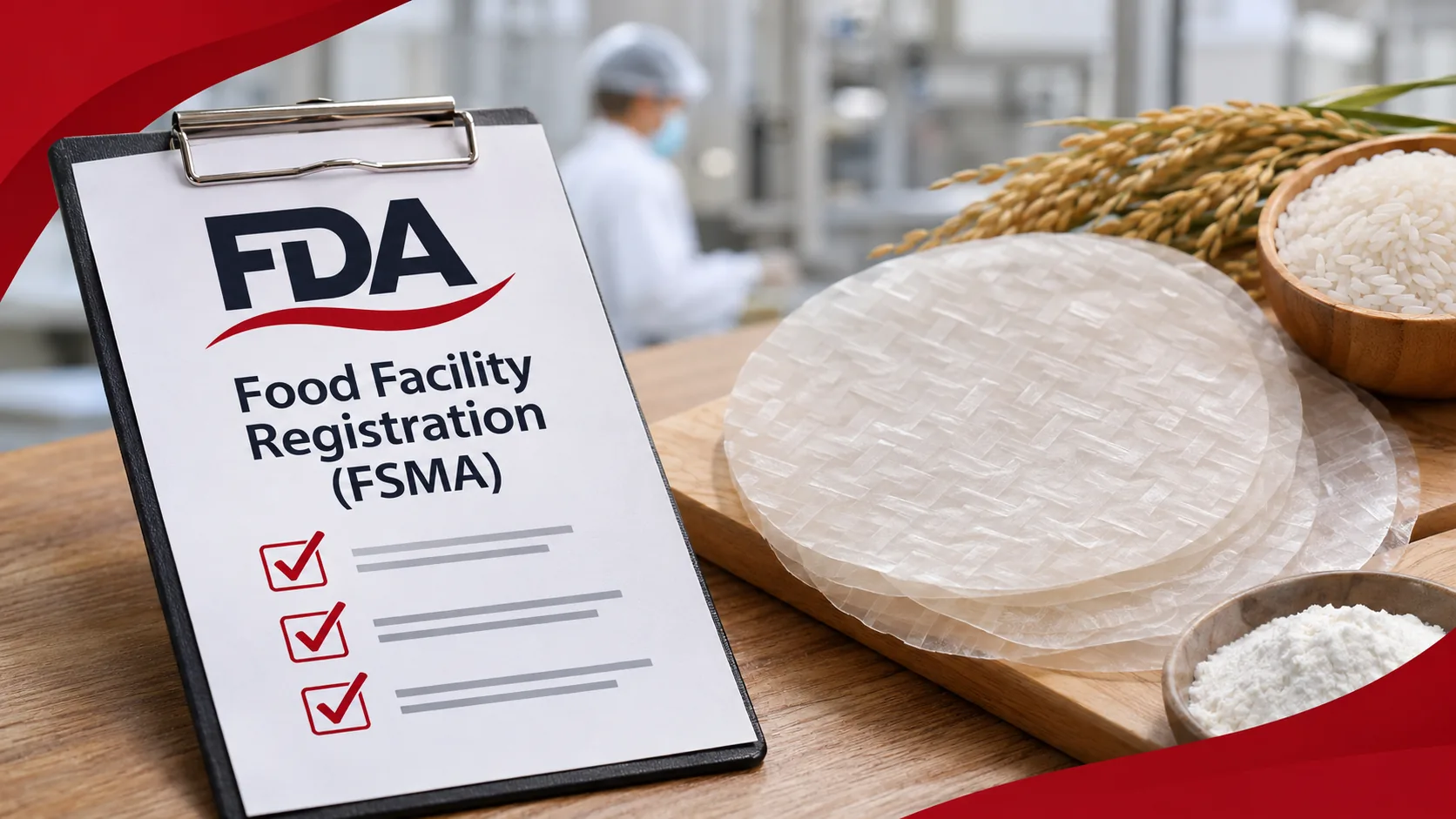
What FDA Food Facility Registration Actually Confirms
The registration confirms that a facility's name, address, type of operation, and Unique Facility Identifier (UFI) have been correctly declared to the FDA.
How FDA Registration Differs From FSSC 22000 and ISO 22000:2018
These three names are often lumped together under "food certification," but they are fundamentally different, and that difference directly affects what a buyer can actually rely on.
| Criteria | FDA Registration | FSSC 22000 / ISO 22000:2018 |
| Governing body | U.S. government agency (FDA) | Private certification body, accredited by an accreditation organization |
| What is checked | The facility's declared information (name, address, UFI) | The entire food safety management system, verified through on-site audits |
| Public database to verify? | No | Yes (FSSC's public register, IAF CertSearch for ISO) |
| Direct assessment of practices at the factory? | No | Yes, through a two-stage audit and periodic surveillance audits |
When FDA Registration Alone Isn't Enough
If your own end customer, say a retailer or a brand, requires a supplier to hold certification under a GFSI-recognized scheme, FDA registration alone does not meet that requirement. In that case, ask further about FSSC 22000 or ISO 22000:2018.
Who Must Register, and What the Process Actually Involves
The rule applies to both domestic U.S. facilities and foreign facilities that manufacture, process, pack, or hold food intended for U.S. consumers, with some groups exempted, such as farms or restaurants. The registration process includes these main steps:
- Obtain a Unique Facility Identifier (UFI). The FDA currently accepts a DUNS number (Data Universal Numbering System) as a valid UFI.
- Submit the registration through the FDA's electronic system (FURLS/FIS).
- A foreign facility must designate a U.S. Agent, who acts as the official point of contact with the FDA in the United States.
- Update the information within 60 days of any change to the name, address, or type of operation.
- Renew the registration every two years, within the window of October 1 through December 31 of even-numbered years.
The Role of the "U.S. Agent" for Foreign Facilities
A U.S. Agent is an individual or organization based in the United States, authorized by a foreign facility to act as its point of contact with the FDA. Buyers can ask for the U.S. Agent's name and contact information as a secondary verification point, since this information is required in the registration record.
How to Verify a Supplier's FDA Registration
This is the biggest difference compared to FSSC 22000 or ISO 22000:2018. Both of those certifications have public lookup systems, but FDA food facility registration does not. A buyer cannot simply type a company's name into an FDA website to confirm it. Verification therefore has to rely on the following steps:
- Ask the supplier for the registration number and request direct confirmation of its current status, since there is no public lookup tool to check it yourself.
- Request a copy of the registration confirmation or the most recent renewal confirmation.
- Match the legal entity name and factory address on the registration record against the actual facility that will produce your order, not a representative office or a different branch.
- Ask about the designated U.S. Agent if it is a foreign facility, and request contact information for cross-verification if needed.
- Combine this with certifications backed by real audits, such as FSSC 22000, ISO 22000:2018, or Halal, since FDA registration alone does not assess food safety practices at the factory.
Frequently Asked Questions About "FDA Certification"
Is there such a thing as "FDA certification" for food? No. The FDA does not issue certificates or approvals for individual food products. The actual requirement is Food Facility Registration under FSMA.
Does FDA registration mean the product has been inspected or approved by the FDA? No. Registration only confirms that a facility has submitted its information to the FDA. It does not include inspection or approval of individual products.
How often must a food facility renew its FDA registration? Every two years, within the window of October 1 through December 31 of even-numbered years.
Can a buyer look up a supplier's FDA registration number themselves? There is no public database for this. The practical approach is to ask the supplier for the registration number and a direct confirmation.
Does FDA registration replace FSSC 22000 or ISO 22000:2018? No. These are two different types of requirements. FDA registration is a mandatory administrative procedure for exporting to the U.S., while FSSC 22000 and ISO 22000:2018 are food safety management system certifications backed by independent audits.
What if a foreign facility doesn't have a U.S. Agent? A U.S. Agent is a mandatory part of a foreign facility's registration record. Missing this information is a point worth questioning before trusting any FDA registration claim.
Tanisa and U.S. Market Compliance
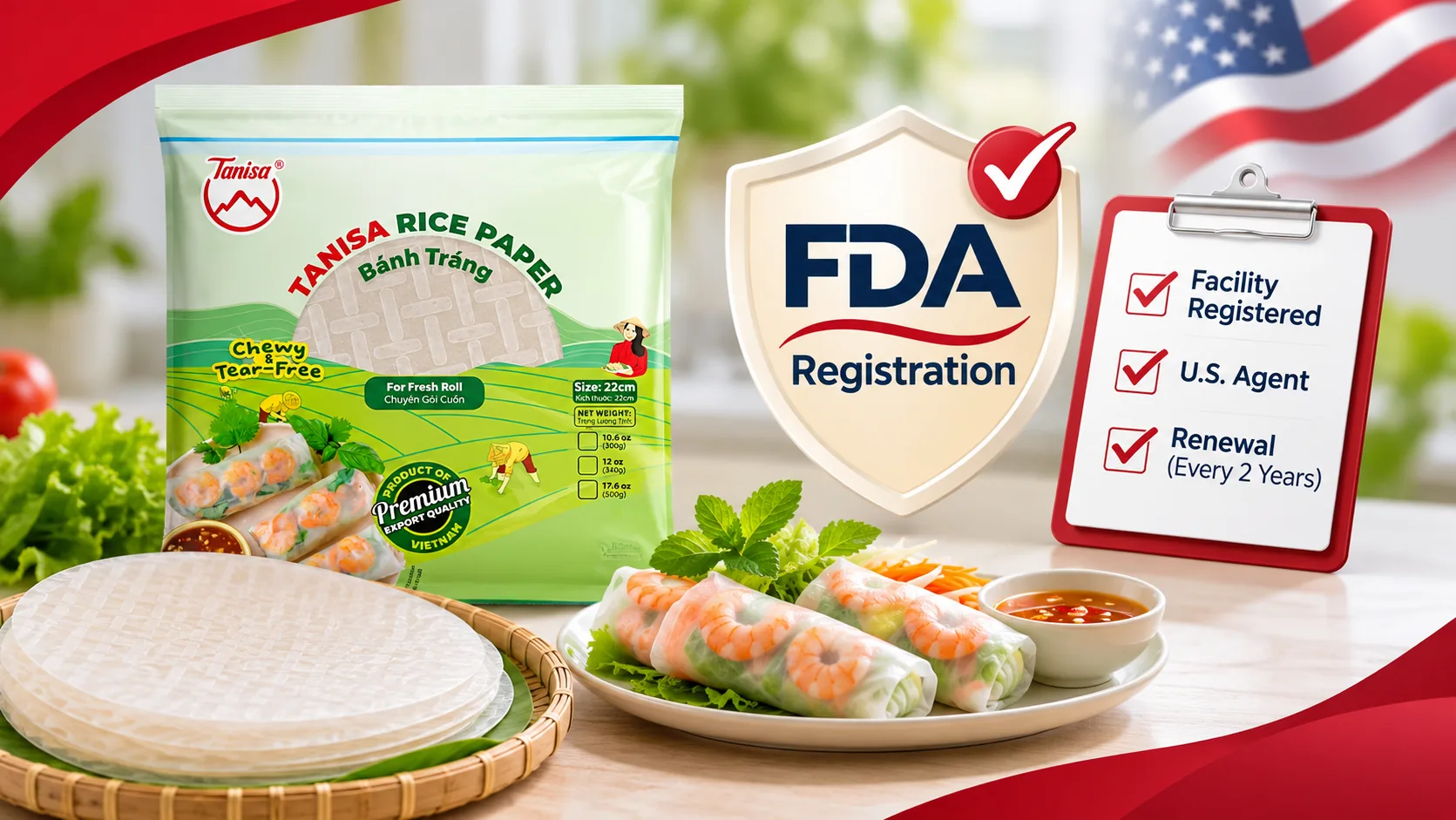
Tanisa Foods is a Vietnamese manufacturer of rice paper and rice-based products, exporting to more than 45 countries, including the United States. The company holds FDA food facility registration for this market, alongside FSSC 22000, ISO 22000:2018, KFDA (South Korea), and Halal certifications. For buyers evaluating a rice paper or rice-based supplier, these are documents worth requesting directly, alongside verifying FDA registration using the steps outlined above.
Related reading: Leading Rice Paper Manufacturer and Exporter - TANISA FOODS JSC.
Tanisa Foods JSC is a leading Vietnamese manufacturer of rice paper, rice noodles, and rice vermicelli, exporting to over 45 countries worldwide. We comply with international food safety standards, including FSSC 22000, ISO 22000:2018, FDA, KFDA, and Halal.
TANISA FOODS JSC
Factory add 1: 188 Lac Long Quan Street, Quarter 3, Tan Ninh Ward, Tay Ninh Province, Vietnam
Factory add 2: Phu Hoa Dong, Cu Chi, Ho Chi Minh City, Viet Nam
Office in HCMC: 18th Floor, Vincom Building, 72 Le Thanh Ton Street, District 1, Ho Chi Minh City, Vietnam
Warehouse in HCMC: 2/3 Binh Gia, Tan Binh District, Ho Chi Minh City, Vietnam
Hotline: +84 938 118 699 (WhatsApp/WeChat), +84 938 198 299 (Zalo)


Email: marketing@tanisagroup.com
Website: www.tanisagroup.com
Facebook: Tanisa Foods JSC
Instagram: @tanisa_foods
Youtube: Tanisa Kitchen

Read more