


KFDA: When Exporting to South Korea
KFDA vs MFDS explained: Learn what MFDS actually requires for exporting food to South Korea, and how to verify a supplier's registration status.
"KFDA" is a term that still shows up in many company profiles, product catalogs, and advisory articles about exporting food to South Korea. A closer look, however, shows that the agency behind this name stopped existing in 2013. The Korean Food and Drug Administration, known as KFDA, was reorganized that year and upgraded into the Ministry of Food and Drug Safety, abbreviated MFDS. For a business preparing to export, understanding what this term actually refers to means preparing the right paperwork from the start, instead of spending time looking for a document that no longer exists.
The name KFDA remains common out of habit, and because many older documents were never updated with the new name. The agency that actually issues facility registrations and inspects food imported into South Korea today is MFDS. The rest of this article looks at what MFDS actually requires, how that differs from FSSC 22000 and ISO 22000:2018, and how to check whether a supplier genuinely meets these requirements.
From KFDA to MFDS
In 2013, South Korea reorganized its food and drug regulatory agency. KFDA was elevated to ministry level and renamed the Ministry of Food and Drug Safety, while more regulatory authority was delegated to regional bodies instead of being concentrated in a single central office. The name change was meant to expand the agency's role beyond food and drugs to cover cosmetics and medical devices as well.
The name KFDA still appears in many company profiles, certification logos, and search results for two reasons. First, many documents were drafted before 2013 or copied from older material that was never updated. Second, in international trade communication, "KFDA" has simply become a familiar shorthand, much the way people still say "Korea's FDA" even though the current legal name is MFDS.
Is KFDA the Same as MFDS?
Functionally, yes. MFDS is the direct successor to KFDA and continues to regulate the safety of food and drugs imported into South Korea. Legally, no. If a partner or supplier refers to "KFDA certification" today, what they actually mean is the current requirements set by MFDS.
What Does "KFDA/MFDS" Actually Require?
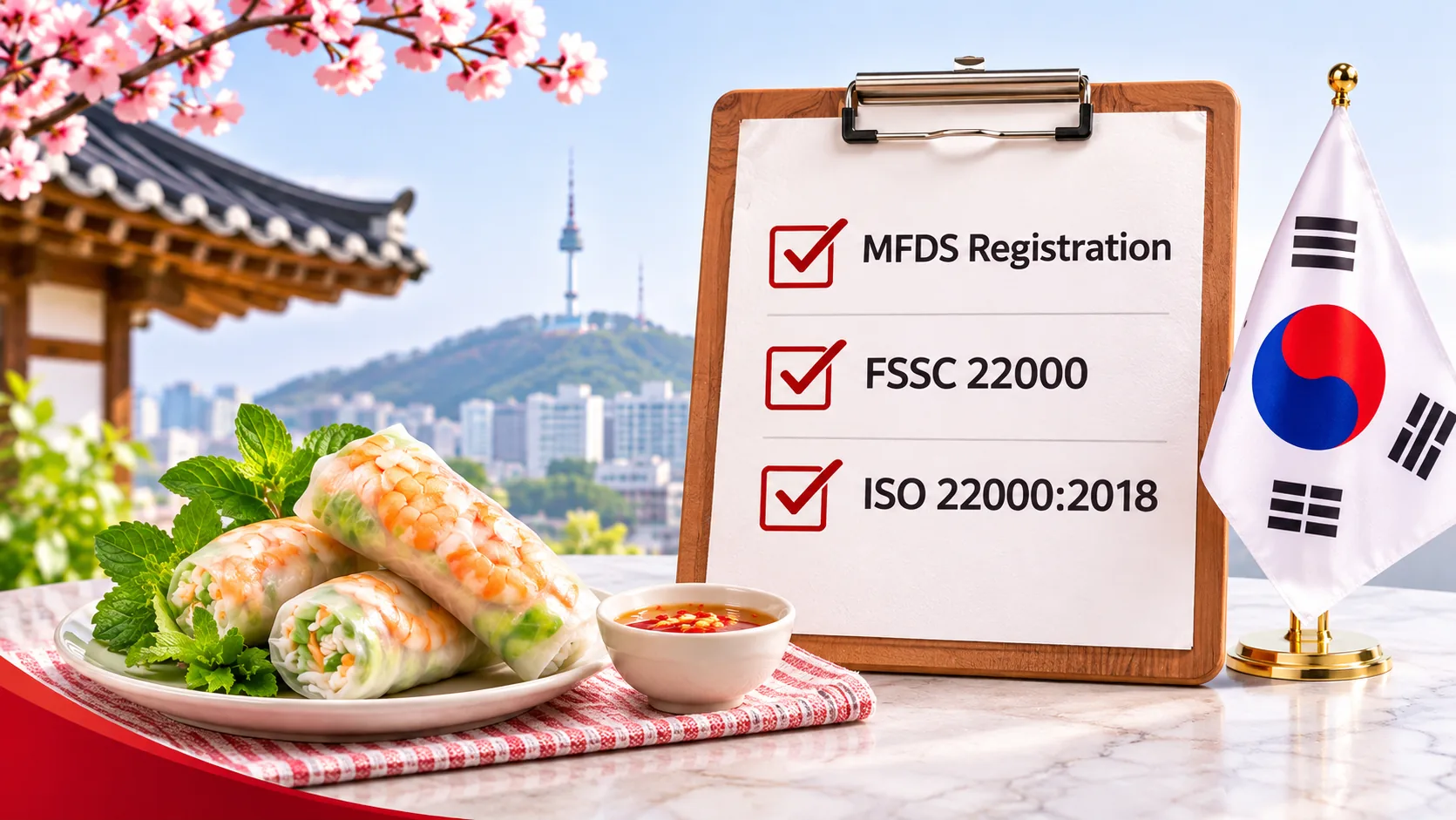
This is where most of the confusion comes from. There is no PDF certificate called a "KFDA Certificate" that a factory can obtain once and use indefinitely, the way FSSC 22000 or ISO 22000:2018 work. Legally bringing food into South Korea actually involves two separate parts.
Part one, overseas manufacturing facility registration. Under South Korea's Special Act on Imported Food Safety Control, a foreign manufacturing facility must register its name, address, and product lines with MFDS before the first shipment is declared for import. Registration is filed through the Imported Food Information System, known as IFIS, either by the Korean importer or the overseas facility. Registration is valid for 2 years, and a renewal application can be filed within 180 days before the expiration date.
Part two, inspection at customs clearance. Every product imported into South Korea for the first time is automatically placed in the highest inspection category, known as Grade 1, and must undergo physical, chemical, and microbiological laboratory testing. For ordinary processed foods, this process typically takes about 10 business days.
Documents Needed for Facility Registration
The core document is the Factory Verification Document, a confirmation issued by the competent authority in the exporter's own country stating that the facility is properly licensed or registered under local food law, along with the facility's legal name and address in English. This is usually accompanied by a copy of the business license, a production flow diagram from raw material to finished product, a product specification sheet with shelf life, a facility layout diagram, and a water quality report if water is used in production. Certificates such as HACCP, GMP, or ISO 22000 are not mandatory but are worth including, since they help the application move forward more smoothly.
The 5-Year Same-Product Rule
If the country of manufacture, the manufacturing facility, the production method, and the raw material names all remain unchanged, shipments imported again within 5 years of the date of the first inspection result only need a document review, which usually takes about 2 days, instead of being tested again from scratch. On the other hand, changing the manufacturing facility, switching to a different contract manufacturer, reformulating the product, or even changing the packaging color can send the product back into Grade 1 and trigger a full re-inspection.
How Is KFDA/MFDS Different from FSSC 22000 and ISO 22000:2018?
These three names are often lumped together under "food certification," but they are fundamentally different things.
| Criteria | KFDA/MFDS | FSSC 22000 | ISO 22000:2018 |
| Nature | South Korea's own import regulation | Food safety management system certification recognized by GFSI | International standard for a food safety management system |
| Issued or confirmed by | A South Korean government agency (MFDS) | An accredited, independent certification body | An accredited, independent certification body |
| Scope | Applies only to goods imported into South Korea | Accepted across many markets and retail systems | Widely accepted, though not a GFSI-recognized scheme |
| Concrete evidence | A facility registration number and clearance records for each shipment | A certificate with a registration number, searchable in a public database | A certificate with a registration number, verifiable through the certification body |
Why a Factory Still Needs Both
Registering with MFDS is a mandatory condition for clearing goods into South Korea, but it does not prove that a factory's food safety management system meets international standards. FSSC 22000 and ISO 22000:2018, on the other hand, two certifications Tanisa has covered in detail in separate articles on its website, demonstrate food safety management capability in general, but they do not replace the mandatory MFDS registration required specifically for the South Korean market. A factory serious about exporting to South Korea typically needs both, not one or the other.
How to Check Whether a Supplier Is Ready for the South Korean Market
Before placing an order, a buyer should ask the supplier for the following information:
- The facility's MFDS registration number and its expiration date, since registration is only valid for 2 years.
- Whether the registered product lines match the product actually being imported.
- Whether a previous shipment has already gone through the first-time precision inspection, and whether it still falls within the 5-year window for faster clearance.
- Whether the product label has been prepared to meet South Korean requirements, including the importer's name and address and a nutrition panel based on Korean reference values.
- Whether the factory address on the registration matches the factory that will actually produce the order.
Frequently Asked Questions About KFDA Certification
Is KFDA still the correct name for South Korea's food regulatory agency? No. The current legal name has been the Ministry of Food and Drug Safety, abbreviated MFDS, since 2013. "KFDA" is still widely used but is no longer the official name.
How long does it take to register a factory with MFDS for the first time? For ordinary processed food, registration typically takes about 7 to 14 business days if the application is complete. For animal-origin products such as meat, dairy, or eggs, the process is more complex and can take several months, since it must go through the competent authority of the exporting country.
What happens to the first shipment imported into South Korea? The first shipment is automatically placed in the highest inspection category and must undergo physical, chemical, and microbiological laboratory testing, which typically takes about 10 business days for ordinary food products.
Does a supplier need both MFDS registration and FSSC 22000 or ISO 22000? Yes, if the goal is both to legally clear customs in South Korea and to demonstrate a food safety management system that meets widely recognized standards. These two sets of requirements serve different purposes and do not replace one another.
Tanisa and the South Korean Market
Tanisa Foods is a Vietnamese manufacturer of rice paper and rice-based foods, currently exporting to more than 45 countries, including South Korea through retail channels such as Homeplus and the e-commerce platform Coupang. Tanisa also lists KFDA (Korea) alongside its FSSC 22000, ISO 22000:2018, FDA (USA), and Halal certifications, as part of its recognized export capability in this market.
Tanisa Foods JSC is a leading Vietnamese manufacturer of rice paper, rice noodles, and rice vermicelli, exporting to over 45 countries worldwide. We comply with international food safety standards, including FSSC 22000, ISO 22000:2018, FDA, KFDA, and Halal.
TANISA FOODS JSC
Factory add 1: 188 Lac Long Quan Street, Quarter 3, Tan Ninh Ward, Tay Ninh Province, Vietnam
Factory add 2: Phu Hoa Dong, Cu Chi, Ho Chi Minh City, Viet Nam
Office in HCMC: 18th Floor, Vincom Building, 72 Le Thanh Ton Street, District 1, Ho Chi Minh City, Vietnam
Warehouse in HCMC: 2/3 Binh Gia, Tan Binh District, Ho Chi Minh City, Vietnam
Hotline: +84 938 118 699 (WhatsApp/WeChat), +84 938 198 299 (Zalo)




Email: marketing@tanisagroup.com
Website: www.tanisagroup.com
Facebook: Tanisa Foods JSC
Instagram: @tanisa_foods
Youtube: Tanisa Kitchen

Read more