


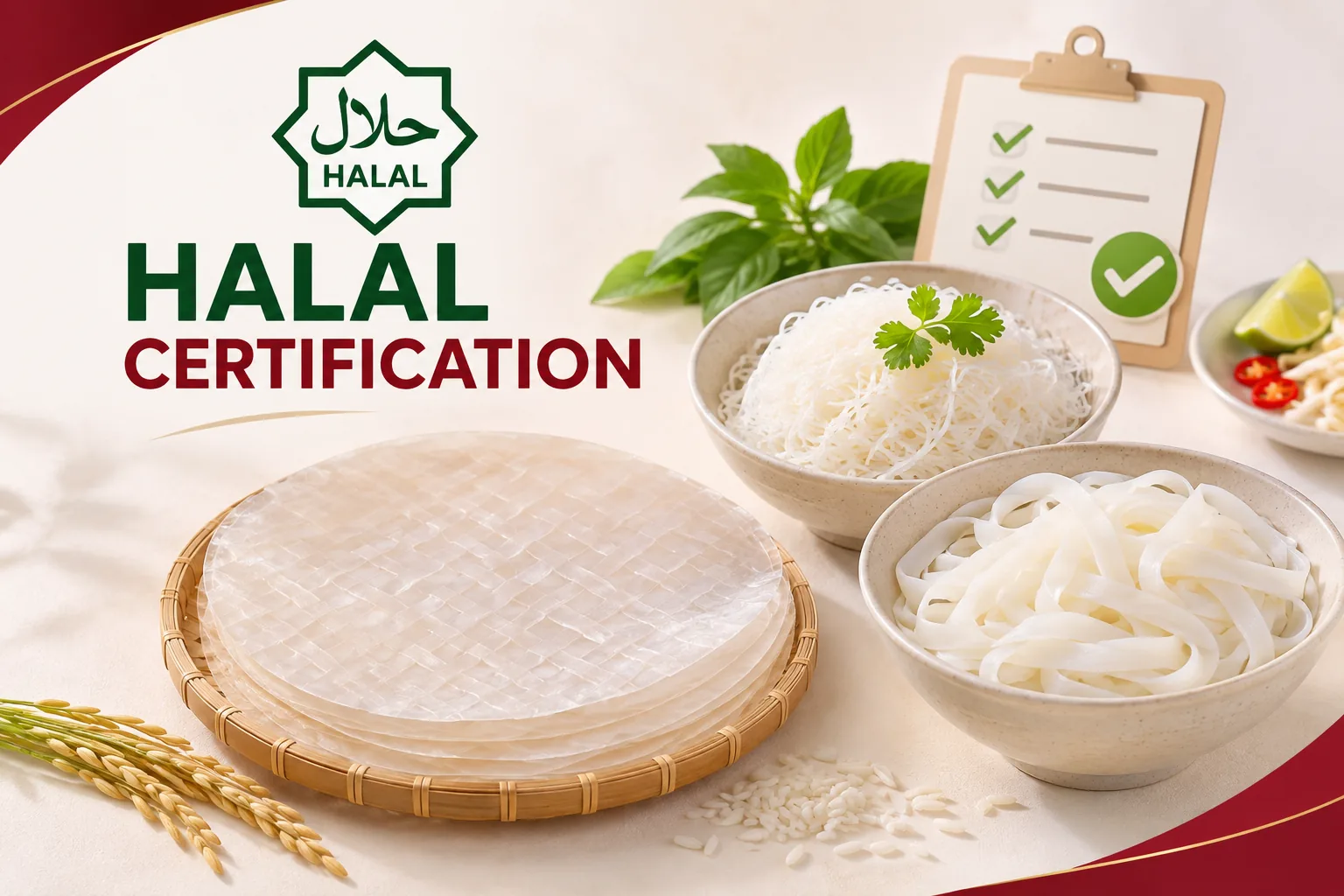
Halal Certification for Rice Paper, Vermicelli & Pho
Halal certification confirms rice paper, vermicelli and pho noodles meet halal standards. See what Tanisa's IFNAS certificate covers and how to check it.
Many people pick up a pack of rice paper on a supermarket shelf, notice the small "Halal" mark printed in the corner, and aren't quite sure what it means. Halal certification is not a marketing slogan. It is the result of a review process covering ingredients, production methods and manufacturing facilities, confirmed in writing by a qualified certifying body. For rice-based foods such as rice paper, vermicelli, pho or sweet potato noodles, where the main ingredient sounds simple enough, this certification usually comes down to details that are easy to overlook: seasoning packets, dipping sauces sold alongside the product, or a production line shared with other goods.
Key Takeaways
- Halal certification is the outcome of a formal assessment by a qualified Islamic organization, not a label a brand can declare on its own.
- For rice paper, vermicelli and pho noodles, the risk usually lies in the seasoning, the dipping sauce and the production line, not just the rice itself.
- Tanisa holds Halal certification issued by IFNAS for a clearly listed group of products, including rice paper, rice paper snack, rice vermicelli, pho, dried rice noodles and a number of ready-to-cook kits.
- Before buying or importing, match the exact product name against the scope stated on the certificate, rather than relying on the Halal logo alone.
What Is Halal Certification, and Who Has the Authority to Issue It?
The Role of a Halal Certifying Body
Halal is an Arabic word meaning permissible under Islamic law (Shariah). A product is considered Halal when its ingredients and the way it is processed do not violate these rules: no ingredients derived from pork, no alcohol, no contact with animal blood, and for animal-based foods, the animal must be slaughtered according to Islamic rites.
Halal certification is the process by which a qualified Islamic organization reviews the entire formulation, the production process and the manufacturing facility, then confirms this with a certificate carrying a specific number, product scope and validity period. Some widely recognized Halal certifying bodies include IFNAS (Islamic Food And Nutrition Society), JAKIM in Malaysia, MUIS in Singapore, IFANCA in the United States, and MUI in Indonesia. Each import market may recognize only certain certifying bodies. For exported goods, what matters is not simply holding a Halal certificate, but whether that certificate is accepted by the importer and the regulatory authority in the destination market.
What a Halal Assessment Actually Checks
A Halal assessment typically covers three areas: the ingredient list and the origin of each component, the production process and the risk of cross-contact with non-Halal lines, and sanitation, storage and transport conditions. This is why a single factory can produce both Halal and non-Halal goods, as long as the processes are kept separate and cross-contact is prevented.
Why Halal Certification Matters for Rice Paper, Vermicelli and Pho Noodles
Rice Paper, Vermicelli and Pho Noodles Are Not Automatically Halal Just Because They Are Made From Rice
Rice paper is made from rice flour, tapioca starch and salt. Vermicelli and dried pho noodles are essentially just rice and water. Looking at the base recipe, many people assume this group of foods is automatically Halal. The reality is a little more complicated, and the detail worth scrutinizing is not the noodle strand or the rice paper sheet itself, but what comes with it.
Take instant noodle or vermicelli kits as an example. The noodles themselves are made from rice, but they come with a seasoning packet, an oil packet, and in some cases a separate chili packet. The seasoning packet alone can contain dozens of different additives, such as flavor enhancers, yeast extract, flavoring powder and coloring. Each of these ingredients needs its origin verified. Similarly, spring roll kits usually come with a ready-made dipping sauce such as fish sauce, peanut sauce or tamarind sauce, and this is exactly where risk tends to appear if it isn't tightly controlled from the start.
The production line is another factor to consider. If a factory produces multiple product lines on the same equipment, the risk of cross-contact between a Halal batch and a non-Halal batch is real, unless cleaning and separation procedures are carried out rigorously and documented.
The Scale of the Halal Market Is Pushing Exporters to Pay Closer Attention
According to market research reports published in 2026, the global Halal food market was estimated at approximately USD 2,956 billion in 2025 and is projected to surpass USD 6,300 billion by 2034, growing at an average rate of more than 8% per year. Indonesia, one of the largest Halal food consumption markets in the world, has made Halal certification mandatory for food and beverage products since October 2024. Malaysia has maintained certification requirements under the JAKIM system for many years. These figures and regulations show that Halal certification is no longer an optional extra, but is becoming a minimum requirement for entry into certain markets.
Inside Tanisa's Halal Certificate: Who Issues It and What It Covers
The Certifying Body and Certification Scope
Tanisa Foods JSC, founded in 2015, holds a Halal certificate issued by IFNAS (Islamic Food And Nutrition Society). The certificate lists the company name and three production and office locations, in Tay Ninh and Cu Chi (Ho Chi Minh City), along with the recognized product list.
The certification scope currently includes:
| Product group | Specific examples |
| Rice paper | Standard rice paper, vegetable rice paper |
| Rice paper snack | Pre-cut mixed rice paper snack |
| Rice vermicelli | White rice vermicelli, vegetable rice vermicelli |
| Pho, dried rice noodles | Dried pho noodles, dried rice noodles in various sizes |
| Vegetable rice vermicelli | Rice vermicelli colored with natural vegetable powder |
| Spring roll kit | Spring roll kit with rice paper, vermicelli and dipping sauce |
| Rice noodle kit | Pho kit, Bun Bo Hue kit |
| Sweet potato noodle | Noodle made from sweet potato starch |
Why the Certification Scope Matters More Than the Logo on the Package
A single factory may produce dozens of different product codes, but Halal certification only applies to the products explicitly listed on the certificate. If a product is not named within the approved scope, it should not be assumed to be Halal as well, even if it carries the same brand.
How to Verify Halal Certification Before Buying or Importing
For Consumers
The simplest approach is to look for the Halal certification mark or logo on the packaging, then match it against the exact product in hand. If no certification mark is visible, or if it's unclear, the safer approach is to ask the retailer or importer directly, rather than assuming Halal status simply because a product is rice-based or appears to be plant-based. For packaging that has already been opened, store it somewhere dry and sealed, away from moisture and strong odors, since rice paper absorbs moisture easily and loses its flexibility if left exposed for too long.
For Importers and Distributors
- Match the product name on the purchase order exactly against the name listed in the certificate's scope.
- Check whether the certifying body is recognized by the regulatory authority in the destination market. For example, Indonesia requires certification to be recognized by BPJPH, while Malaysia relies on the JAKIM system.
Common Misconceptions About Halal-Certified Rice-Based Foods
There are a few misconceptions that come up fairly often when discussing Halal certification for rice-based foods.
Misconception one: Halal is the same as gluten-free or vegan. These are two entirely different criteria. A product can be Halal-certified and still contain gluten, or be gluten-free without holding Halal certification. Buyers need to check the ingredient label and the allergen label separately, rather than inferring one from the other.
Misconception two: if one product is Halal, the whole brand is Halal. As noted above, certification is tied to the specific product scope listed on the certificate, not a blanket label covering the entire company.
Misconception three: rice paper is only used for Vietnamese-style rolls, so Halal status matters less. In practice, rice paper is being used in many markets for non-traditional dishes, from baked and fried preparations to pastry variations in some European countries. When one ingredient is used across many different dishes, the need for Halal certification extends along with it, no longer confined to its original cuisine.
Frequently Asked Questions
Is Tanisa Halal certified? Yes. Tanisa Foods JSC holds a Halal certificate issued by IFNAS, covering a defined group of products: rice paper, rice paper snack, rice vermicelli, pho, dried rice noodles, vegetable rice vermicelli, spring roll kits, rice noodle kits and sweet potato noodles.
Does Halal certification mean a product is gluten-free or vegan? No. These are two independent criteria. Halal certification confirms that the product and its production process meet Islamic requirements, while gluten-free or vegan status relates to ingredient composition, which should be checked separately on the product label.
Can Halal-certified rice paper be used for dishes outside Vietnamese cuisine? Yes. Rice paper, by nature, adapts to many different ways of cooking and is not limited to traditional spring rolls or fried rolls. Many markets already use rice paper for baked dishes, fried dishes or their own recipes.
What should importers request before importing Halal-certified goods? They should request a copy of the current, valid Halal certificate, match the product name against the scope listed on the certificate, and confirm whether the certifying body is recognized by the regulatory authority in the importing market.
How can I tell if a Halal certifying body is recognized in my market? Each market has its own regulatory authority for this, such as BPJPH in Indonesia or JAKIM in Malaysia. The most reliable approach is to ask customs or the food safety authority in the importing market directly, since the list of recognized certifying bodies can change over time.
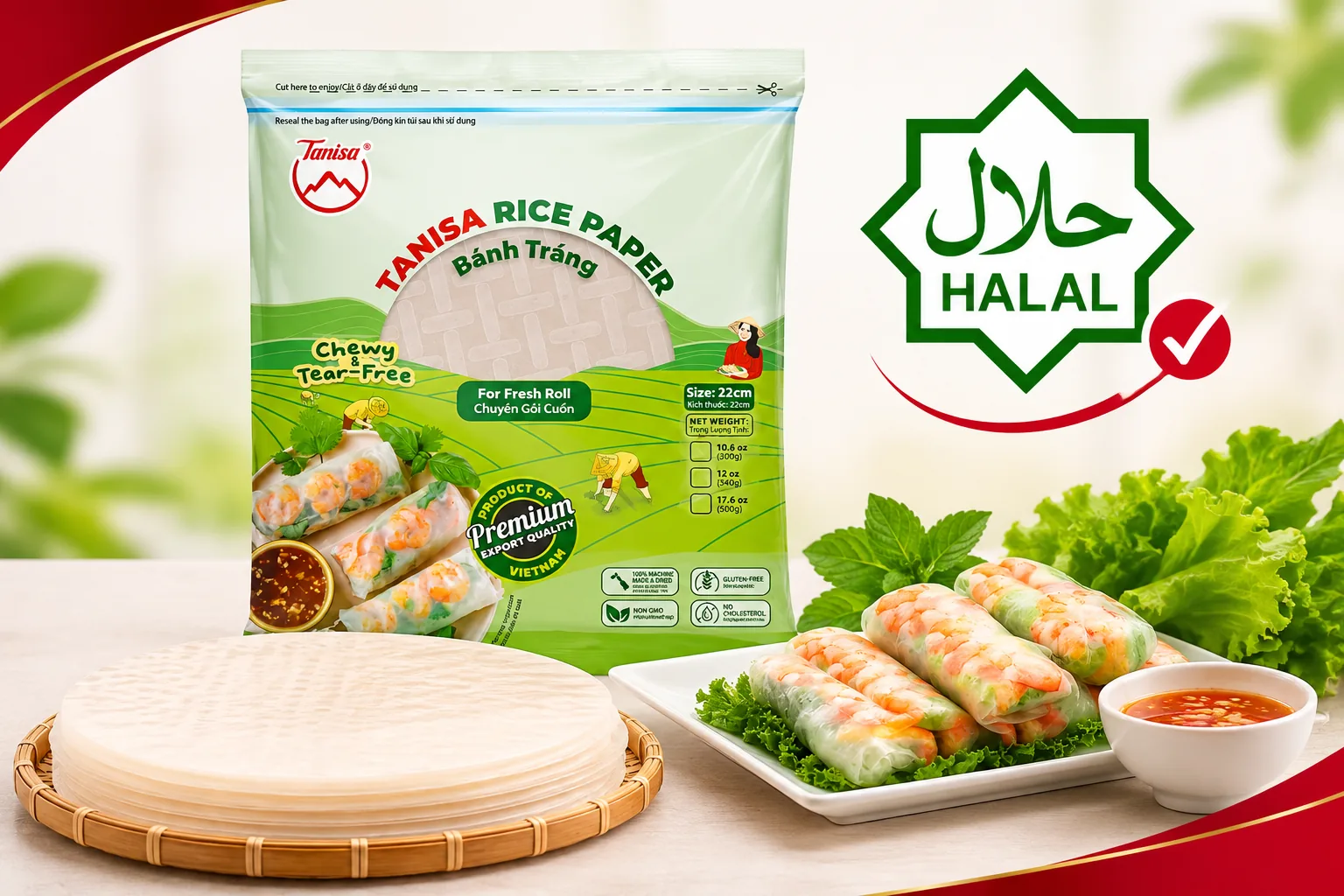
Tanisa Foods JSC is a Vietnamese manufacturer and exporter of rice paper, vermicelli, pho noodles and sweet potato noodles, currently holding Halal certification issued by IFNAS along with FSSC 22000, ISO 22000:2018, FDA (USA) and KFDA (Korea) certifications, exporting to more than 45 countries.
Tanisa Foods JSC is a leading Vietnamese manufacturer of rice paper, rice noodles, and rice vermicelli, exporting to over 45 countries worldwide. We comply with international food safety standards, including FSSC 22000, ISO 22000:2018, FDA, KFDA, and Halal.
TANISA FOODS JSC
Factory add 1: 188 Lac Long Quan Street, Quarter 3, Tan Ninh Ward, Tay Ninh Province, Vietnam
Factory add 2: Phu Hoa Dong, Cu Chi, Ho Chi Minh City, Viet Nam
Office in HCMC: 18th Floor, Vincom Building, 72 Le Thanh Ton Street, District 1, Ho Chi Minh City, Vietnam
Warehouse in HCMC: 2/3 Binh Gia, Tan Binh District, Ho Chi Minh City, Vietnam
Hotline: +84 938 118 699 (WhatsApp/WeChat), +84 938 198 299 (Zalo)

Email: marketing@tanisagroup.com
Website: www.tanisagroup.com
Facebook: Tanisa Foods JSC
Instagram: @tanisa_foods
Youtube: Tanisa Kitchen

Read more