


Rice Paper Meets the Plant-Based Trend
Rice paper is gluten-free, fat-free, and endlessly customizable. Here's why it fits the plant-based trend, plus real nutrition facts and rolling tips.
Rice Paper Meets the Plant-Based Trend: How to Wrap Your Way to a Healthier Meal
Scroll through any grocery aisle and you'll see the same pattern: more "plant-based" labels, more clean-ingredient claims, and fewer products trying to mimic the taste of meat. Rice paper fits into this trend naturally, without even trying. From the start, it was never built around meat. It's simply a thin sheet made from rice flour and water, and what goes inside is entirely up to the person rolling it. That flexibility is exactly what the 2026 plant-based movement is looking for: fewer fixed rules, more real vegetables, less processing. This is where rice paper and plant-based eating truly meet.
Why the Plant-Based Trend Is Booming in 2026
This is no longer a niche story. According to industry trend data from Innova Market Insights and Tastewise, 63% of consumers have tried at least one plant-based product in the past year, and the 2026 Veganuary campaign drew roughly 30 million sign-ups worldwide, about 16% more than the year before.
What's behind the number matters more than the number itself. Health is the top reason people give, cited by 45%, well ahead of environmental concerns at just 32%. Taste and cost remain the two biggest barriers holding consumers back, at 34% and 28% respectively. And more than half of consumers, 55%, now believe plant-based food deserves to be treated as its own category rather than just an alternative choice.
Taken together, this points to a trend built on everyday eating habits, not a fixed identity. Consumers aren't necessarily going fully vegan. They're looking for lighter, simpler meals that don't take much effort, a role rice paper has quietly played for years.
Why Rice Paper Is a Natural Fit for Plant-Based Meals
A Blank Canvas, Not a Fixed Recipe
Most wraps come with an unspoken assumption built in: a tortilla implies a burrito, a nori sheet implies sushi rice and fish. Rice paper carries no such baggage. It adapts to whatever is placed inside it, instead of dictating what should go inside, which is why the same sheet can wrap mango and tofu today and leftover roasted vegetables tomorrow. Wrap whatever you already have on hand.
Clean by Nature
This isn't a marketing angle, it's the actual composition. A plain rice paper sheet runs about 16 calories for a small one, rising to somewhere between 35 and 60 calories for a larger sheet, and it's naturally gluten-free, fat-free, and cholesterol-free, since it's made almost entirely from rice flour and water (some brands add a small amount of tapioca starch for extra pliability). That means the calorie and fat content of the finished roll depends almost entirely on the filling, which is useful for anyone trying to keep a meal light without tracking every ingredient.
No Cooking, No Hassle
There's no stovetop step required. A quick dip in room-temperature water is enough to soften the sheet for rolling, making it one of the few wrap formats that can go from pantry to plate in about the time it takes to slice a few vegetables.
How to Build the Perfect Plant-Based Rice Paper Roll
The Best Plant-Based Fillings to Try
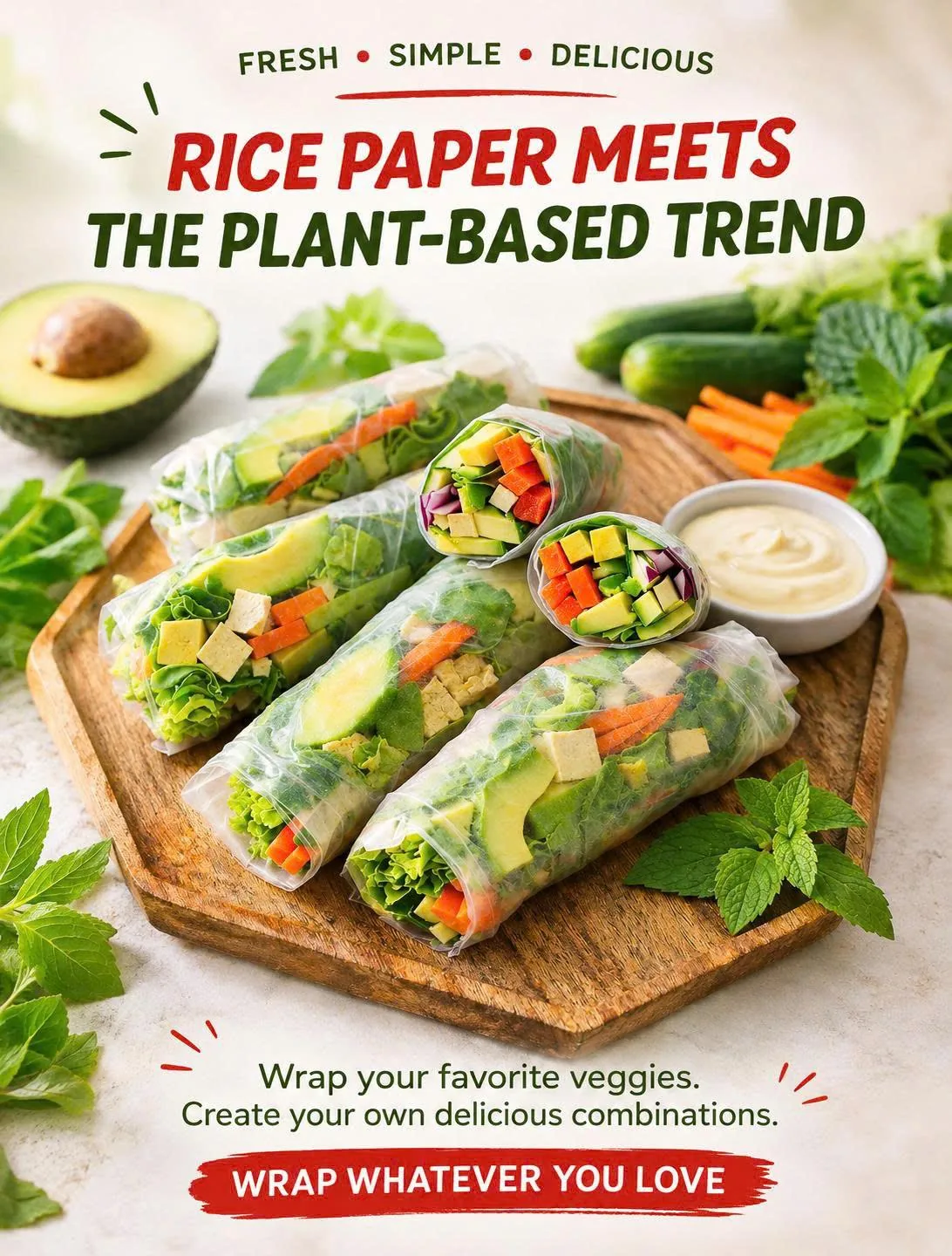
The most reliable combination is avocado for creamy richness, carrot and cucumber for crunch, tofu for protein, lettuce or purple cabbage for bulk and color, and fresh herbs like mint for brightness. None of these are mandatory. Chickpeas, roasted sweet potato, or a spoonful of hummus work just as well if that's what you already have in the fridge.
Four Steps to a Tight, Tear-Free Roll
- Prep first, roll second. Slice everything before touching the rice paper, since the sheet starts softening the moment it hits water and won't wait for you to catch up.
- Soften briefly. A few seconds in water is usually enough; soaking too long makes the sheet sticky and harder to handle.
- Don't overfill. An overstuffed roll is the most common reason rice paper tears while folding. Leave enough room to tuck in the sides before rolling forward.
- Roll with steady, even pressure, not force. Fold in the sides, then roll from the bottom up in one continuous motion rather than several small adjustments.
Dipping Sauces That Keep It Plant-Based
Peanut sauce is the default choice for good reason, but a tahini-lime sauce or a simple soy-ginger dip both keep the roll fully plant-based while offering a different flavor direction.
Rice Paper vs. Other Plant-Based Wraps
Compared to a flour tortilla, rice paper carries noticeably less fat and fewer calories per roll, since the dough itself contains no oil. Compared to a large lettuce leaf, it holds its shape better once filled and doesn't fall apart when handled. Compared to nori, it has a more neutral taste that doesn't compete with the filling.
Creative Variations Already Trending
Fresh, no-cook rolls are the starting point, but they're not the only way people are using rice paper today. A wave of crispy, air-fried rice paper dumplings has been circulating on TikTok, where the sheet is folded around a filling and air-fried or lightly pan-fried until the outside turns golden and shatters slightly with each bite. It's a completely different texture experience from the soft, fresh version, and both stay plant-based as long as the filling does.
FAQs About Rice Paper and Plant-Based Diets
Is rice paper vegan? Plain rice paper, made from rice flour and water (sometimes with added tapioca starch), contains no animal ingredients. Always check the label on unfamiliar brands, since formulas can vary.
Is rice paper healthier than regular wraps? It's lower in calories and fat than most wheat-based wraps, mainly because the dough contains no added fat. Whether the finished roll is "healthier" ultimately depends on the filling.
Can rice paper rolls be baked or air-fried? Yes. Beyond the fresh, no-cook version, air-frying or baking rice paper rolls has become a popular way to get a crispy exterior without deep-frying.
How long do fresh rice paper rolls keep? They're best eaten the same day. Rice paper keeps softening after rolling, so rolls made more than a day ahead tend to lose their original texture, even when stored in an airtight container in the fridge.
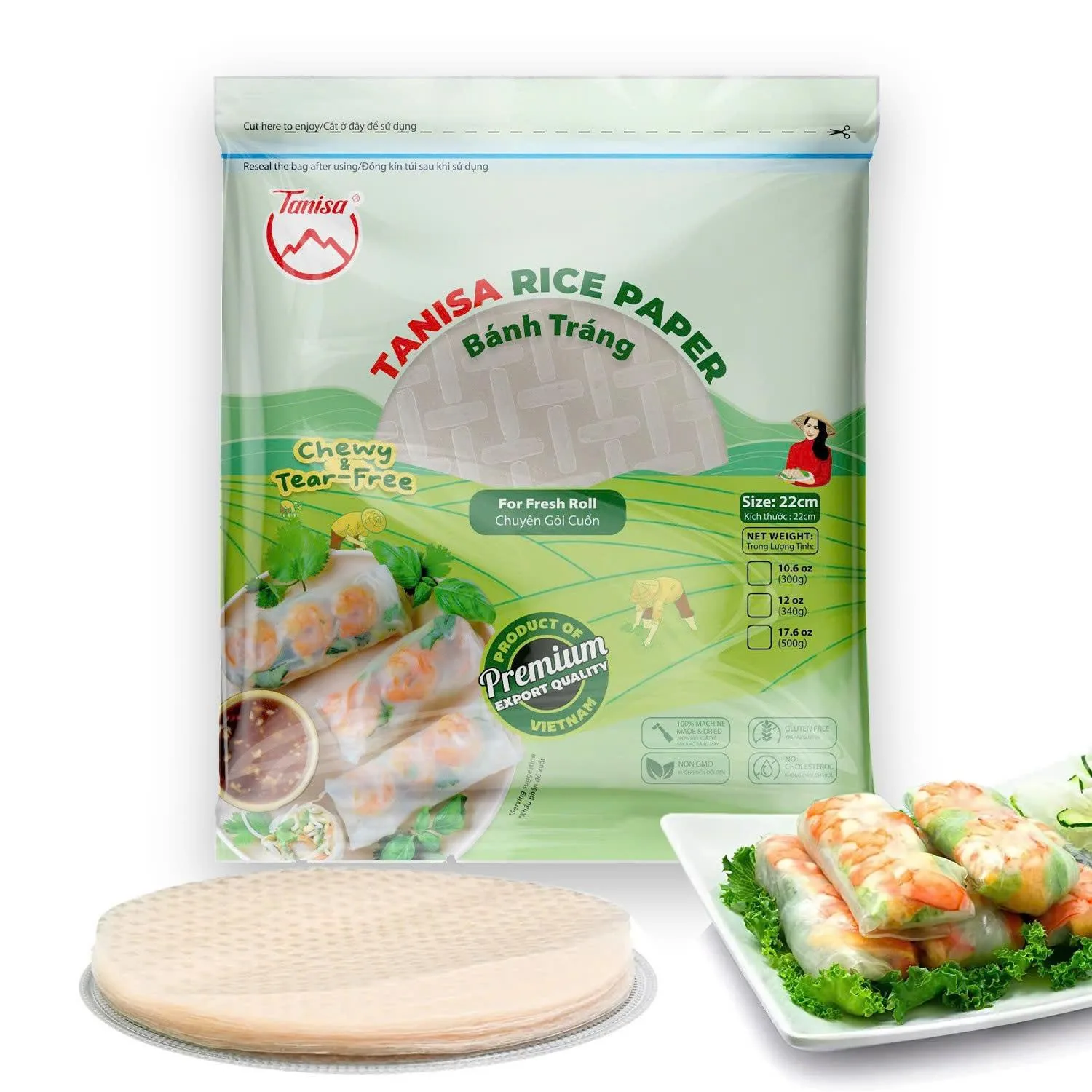
Tanisa rice paper is built around a Chewy & Tear-Free standard: thin yet sturdy sheets that reduce waste and stretch your value further, easy to roll. Tanisa's factory holds FSSC 22000, ISO 22000, Halal, FDA, and KFDA certifications, and the product is now exported to more than 45 countries, including demanding markets such as the United States, Japan, and South Korea.
Tanisa Foods JSC is a leading Vietnamese manufacturer of rice paper, rice noodles, and rice vermicelli, exporting to over 45 countries worldwide. We comply with international food safety standards, including FSSC 22000, ISO 22000:2018, FDA, KFDA, and Halal.
TANISA FOODS JSC
Factory add 1: 188 Lac Long Quan Street, Quarter 3, Tan Ninh Ward, Tay Ninh Province, Vietnam
Factory add 2: Phu Hoa Dong, Cu Chi, Ho Chi Minh City, Viet Nam
Office in HCMC: 18th Floor, Vincom Building, 72 Le Thanh Ton Street, District 1, Ho Chi Minh City, Vietnam
Warehouse in HCMC: 2/3 Binh Gia, Tan Binh District, Ho Chi Minh City, Vietnam
Hotline: +84 938 118 699 (WhatsApp/WeChat), +84 938 198 299 (Zalo)




Email: marketing@tanisagroup.com
Website: www.tanisagroup.com
Facebook: Tanisa Foods JSC
Instagram: @tanisa_foods
Youtube: Tanisa Kitchen

Read more